Please see my previous post on the process behind this post. I have created a PDF version and below the blog post version, so you have the format of your choice.
[This is a draft version, the full version will be published in JIME.
September 2009]
Is the revolution justified?
Introduction
It is common for observers and bloggers (including myself) in educational technology to proclaim that current educational practice is, in some way, ‘broken’. It is seen as not delivering deep learning, or failing to meet the needs of students, and of potentially becoming irrelevant to a new generation of digital learners. For example, here I am arguing that the online learning environment can be seen as a metaphor for the change needed by universities:
“that the online learning environment is not peripheral, or merely a technological issue for universities and educators to resolve, but rather that it represents the means by which higher education comes to understand the requirements and changes in society, and thus the route by which it maintains its relevance to society.” (Weller 2009)
And here is John Seely-Brown (2006) making a compelling claim for the need for change in education:
“As the pace of change in the 21st century continues to increase, the world is becoming more interconnected and complex, and the knowledge economy is craving more intellectual property.”
And Marc Prensky’s (2001) opening statement for his digital natives article claims that students have changed radically:
"It is amazing to me how in all the hoopla and debate these days about the decline of education in the US we ignore the most fundamental of its causes. Our students have changed radically. Today’s students are no longer the people our educational system was designed to teach."
Carie Windham (2005) makes a claim about the irrelevance of higher education:
“In a world where technologies change daily and graduates armed with four-year degrees are entering the workforce in record numbers, there is an increasing fear among the Net Generation that a four-year degree will be neither relevant nor sufficient preparation when it becomes time to enter the work force.”
Given the abundance of new technologies it is tempting to make an argument based on the affordances of new technologies, and from a pedagogic perspective the manner in which existing pedagogy maps onto a physical, resource limited environment. However, the aim of this paper is to examine the empirical evidence for any change in higher educational practice, based on the behaviour of online learners.
I wanted to examine whether there was any real justification for such claims and predictions. So, I decided to take a similar approach to Descartes, which is to remove the opinions and values that I have formed so that I may start afresh and see if a solid basis can be found:
“as for the opinions which up to that time I had embraced, I thought that I could not do better than resolve at once to sweep them wholly away, that I might afterwards be in a position to admit either others more correct, or even perhaps the same when they had undergone the scrutiny of reason.”
The Net Generation
This isn’t a net generation essay, but that literature represents a good starting point, since many of the claims for educational reform are justified by reference to the net generation, or digital natives. I examined much of the literature to see when these claims were actually backed up by research. The following are potential areas where we could extrapolate a need to alter educational practice.
Context
In the spirit of Descartes, we need to start with some obvious, but basic foundations: The
cogito ergo sum of educational technology. So first, let’s examine the evidence that students use computers and the internet at all in learning.
It seems a truism to say that current university students and younger have greater exposure to ICTs than previous generations. Marc Prensky (
ibid) bases much of the digital natives argument on the fact that “today’s average college grads have spent less than 5,000 hours of their lives reading, but over 10,000 hours playing video games (not to mention 20,000 hours watching TV).” We know that accessing computers and the internet for learning is now so commonplace as to seem normal. The UK Children Go Online report (
Livingstone and Bober 2005) states that “90% of 9-19 year olds who go online daily or weekly use the internet to do work for school or college and 94% use it to get information for other things.” And that “75% of 9-19 year olds have accessed the internet from a computer at home.”
Further to this we know that students value computers and the role they play in learning. In a study of higher education students in South Africa, Czerniewicz and Brown (2008) found that “72% of students were extremely positive about the role of computers in learning and have a high opinion of their own abilities/self efficacy.” They also found that students used computers for learning even when they were not
asked to do so, and they used computers informally. This was particularly evident in the case of communicative media where 55% of staff asked students to use communicative media as part of their courses, yet 75% of students reported using communicative media regularly for their learning.”
And this informal learning theme is continued by Oblinger and Oblinger (2005) who reference Grunwald (2003) “When teenagers are asked what they want from the Internet, the most common response is to get "new information." Close behind, at about 75 percent, is to "learn more or to learn better." The use of the Internet to learn is not limited to school work. Students are often informal learners, seeking information on a variety of topics, such as personal health.”
We therefore have a basis to go forward: that students do at least use technology, value it and go beyond what they are formally required to do. This in itself of course does not necessitate a revolution, so let us examine some further areas under the general Net Generation research.
Lack of relevance
Having established that students seem to value ICT we could ask the same of educators. Here the picture is less clear, Czerniewicz and Brown (
ibid) found that unlike students, staff
“didn’t know whether or not their colleagues thought computers were important. When they did report knowing about their colleagues use and attitudes towards computers, they were divided about their opinions as to their colleagues’ values and use, indicating limited support networks and communities of practice.”
There are some differences in the use of technologies across generations, for example Oblinger and Oblinger (ibid) report that 74 percent of teenagers use IM as a major communication tool compared to 44 percent of online adults. Livingstone and Bober (ibid) have similar differences in ICT competence, “only 16% of weekly and daily user parents consider themselves advanced compared with 32% of children”
Hartman et al (2005) looked at reactions to online courses across three ‘generations’ and found that “The Net Gen respondents were disappointed; they perceived a lack of immediacy in their online courses and felt that faculty response times lagged behind their expectations.” The attitude towards online learning seems to change across the generations: “Baby Boomers preferred some face-to-face encounters with their instructors; Generation X students reported substantial, pointless interaction in class; and the Net Gen students felt that the interaction mechanisms designed by their instructors were much less adequate than their personal technologies.” This would suggest that the Net Generation do have a comparison to make around interactivity that may be relatively new.
Roberts (2005) reports the findings of a survey which suggest that for modern students “customization is central to the definition of technology for Net Geners. Technology is something that adapts to their needs, not something that requires them to change”
There may be proxies that we need to examine for the alleged irrelevance of education also, for instance truancy rates now at their highest levels in England (http://www.guardian.co.uk/education/2008/feb/27/schools.uk1) and there is also an increase in the number of students suspended from school.
(http://www.guardian.co.uk/politics/2008/oct/25/truancy-school-suspensions). These figures themselves are subject to much interpretation, and what they signify is even more ambiguous. Of course, none of this necessarily points to problems with education, it could be a result of social pressures for instance, and even if it does relate to educational irrelevance, we don’t know that technology is necessarily the
solution.
In conclusion then we have some moderate evidence that there may be some differences in the expectations of net generation learners, and possibly an increase in dissatisfaction with education. There is a question whether these expectations are really unique to the net generation, which we will look at later.
Different attitudes
A Pew Internet report (
Lenhart et al 2008) on teens and writing points at some differences in attitude between generations. Parents think teenagers do more ‘writing’ than they did, but the teenagers don’t see what they do as writing, they see it as communication or socialising. They separate academic writing from informal communication using technology.
They found some use of technology to improve writing:
“Teens who communicate frequently with friends, and teens who own more technology tools such as computers or cell phones do not write more for school or for themselves than less communicative and less gadget-rich teens. Teen bloggers, however, are prolific writers online and offline.
- 47% of teen bloggers write outside of school for personal reasons several times a week or more compared to 33% of teens without blogs.
- 65% of teen bloggers believe that writing is essential to later success in life; 53% of non-bloggers say the same.”
Of course this does not mean blogging causes them to write more, so making the nonbloggers keep blogs would not necessarily improve writing – those who like writing and have an aptitude for it are likely to keep blogs.
Another area where there may be a difference in attitude relates to ‘cut and paste’ or plagiarism, with younger people seeing less of a ‘crime’ in relation to copying: “Among 12-19 year olds who go online daily or weekly, 21% admit to having copied something from the internet for a school project and handed it in as their own.” (Livingstone and Bober), although we do not have comparison figures for previous generations who may have copied from text books.
Again the evidence is weak to absent that there is a major generational shift here, but there does seem to be some hints to subtle differences regarding standard educational practice and the way technology impacts upon this.
Overestimating skills
A common theme from a number of recent reports seems to be that far from being the tech-savvy, digitally immersed cyborgs portrayed in much of the literature, there are some relatively poor information skills amongst the net generation, and a good deal of variance.
For example Brown (2009) reports: “Recently, the Nielsen Norman Group study of teenagers using the web noted: “We measured a success rate of only 55 percent for the teenage users in this study, which is substantially lower than the 66 percent success rate we found for adult users.” The report added: “Teens’ poor performance is caused by three factors: insufficient reading skills, less sophisticated research strategies, and a dramatically lower patience level.”
The Google Generation report produced by the British Library (2008) also explored some of the myths and found that:
- young people have a poor understanding of their information needs and thus find it difficult to develop effective search strategies as a result, they exhibit a strong preference for expressing themselves in natural language rather than analysing which key words might be more effective
- faced with a long list of search hits, young people find it difficult to assess the relevance of the materials presented and often print off pages with no more than a perfunctory glance at them
And Livingstone and Bober state that:
"Many children and young people are not yet taking up the full potential of the internet, for example visiting a narrow range of sites or not interacting with sites… 38% of pupils aged 9-19 trust most of the information on the internet, and only 33% of 9-19 year olds daily and weekly users have been taught how to
judge the reliability of online information”
Bennett et al (2008) provide an excellent analysis of many of the claims around the Net generation and have found a similar pattern of overestimating the information skills of the young:
“These studies also found that emerging technologies were not commonly used, with only 21% of respondents maintaining a blog, 24% using social networking technologies, and 21.5% downloading podcasts.”
This leads me onto the next point about the net generation literature, which is that it makes claims of generational difference with little basis.
Seeing difference where there is none
Some of the net generation literature seems to make claims of supposed generational difference when none exists. For example, multi-tasking is often set forward as a new ‘skill’, but Bennett
et al respond that “there is no evidence that multi-tasking is a new phenomenon exclusive to digital natives. The oft used example of a young person doing homework while engaged in other activities was also applied to earlier
generations doing homework in front of the television.”
And Oblinger and Oblinger (ibid) claim as one of the defining characteristics of the net generation that “they want parameters, rules, priorities, and procedures … they think of the world as scheduled and someone must have the agenda. As a result, the like to know what it will take to achieve a goal. Their preference is for structure rather than ambiguity.” Which begs the question, ‘was there evidence that previous generations had a stated preference for ambiguity and chaos in their learning?’
Mark Bullen makes a similar point about claims to the increased irrelevance of education to net geners “The relevance of education has been source of debate for as long as I have been in education. I remember, as a student, participating in a ‘walkout’ from my high school in 1970 over the perceived irrelevance of our education.”
(http://www.openeducation.net/2008/09/23/net-generation-nonsense-mark-bullendiscusses-teaching-and-learning/)
And while we may point to factors such as an increase in truancy to support the claim
that school is seen as irrelevant, similar angst was to be found about truancy rates in
1908 in New York (http://query.nytimes.com/gst/abstract.html?res=9502E3D71738E033A2575BC0A9639C946897D6CF). One issue is that people are often making claims when we have no comparison to judge them against. We don’t know if students today are less satisfied with education than say, 40 years ago, and even if we did, assigning causality would be difficult – it could be the result of massive expansion in higher education, for example.
One of the conclusions we may reach is that differences within generations seem as great as those between them. For example compare responses of the young to the general population in this 2007 OCLC survey in which college students and members of the general public were asked the following question:
“How likely would you be to participate in each of the following activities on a social networking or community site if built by your library?”
The numbers are those who say they are extremely likely or very likely to do so (general public responses in brackets)
- self-publish creative work: 7% (6%)
- share ideas with about library services: 10% (7%)
- share your photos / videos: 7% (6%)
- participate in online discussion groups: 6% (6%)
- meet others with similar interests: 6% (7%)
- describe your own personal collections: 9% (6%)
- view others’ personal collections: 12% (6%)
(of course the students could be objecting to the ‘built by your library’ element of the question, not the tasks themselves, which they might happily perform in Facebook).
There are changes which we might attribute to the digital age that seem to be crossgenerational – for instance there seems to be a general decline in the amount of literature reading (http://www.nea.gov/news/news07/TRNR.html). This may have a greater impact on the younger generation, who may never develop reading skills, but it does not necessarily separate them out from other generations.
Overall, like Bennett et al I have found little strong evidence for the main claims of the net generation literature, which they summarise as
“1. Young people of the digital native generation possess sophisticated knowledge of and skills with information technologies.
2. As a result of their upbringing and experiences with technology, digital natives have particular learning preferences or styles that differ from earlier generations of students”
However, for education it may not matter if this a generational or a societal shift. If everybody is changing their behaviour then education still needs to respond. ‘Mature’ students now exceed those in the traditional age range of 18-22 in the US now. So in this respect the Net gen discussion is something of a red herring. What we need to be concerned about is the changes in the digital society.
People are learning in different ways
If we are less focused purely on the net generation, but with changes in society as a whole, then we need to look beyond students in formal education. Firstly, let us start with some broad statistics of internet usage, which may relate to learning. Let us look first at the behemoth of the internet: Google. Statistics vary, with one report stating that in August 2007, Google was “handling 1200 Million searches per day on average
worldwide. In June 2007, Wikipedia received an average of 55.6 Million referrals per day from Google.” (
http://notes.jschutz.net/9/internet-search/google-searches-per-day)
Obviously these searches are not all related to learning, and when they are, it may be learning at a very cursory level. The 55.6 million referrals to Wikipedia hint at a greater depth of learning, at least to the sort of level of interest we see when people consult an encyclopedia. If we take Wikipedia as the exemplar for online information resource, then it has 2,725,998 pages, with the average user visiting around 4.5 pages
per day
(http://www.alexa.com/data/details/traffic_details/en.wikipedia.org/wiki/Main_Page)
If we take Facebook as our representative for social activity online then we have: over150 million active users; the average user has 120 friends; more than 15 million users update their statuses at least once each day; more than 850 million photos uploaded to the site each month; and more than 24 million pieces of content (web links, news stories, blog posts, notes, photos, etc.) shared each month.
(http://www.facebook.com/press/info.php?statistics)
And lastly, YouTube as an example of new content creation: In June 2008, 91 million viewers watched 5 billion user-posted videos on YouTube, and 1-10% YouTube users are creators (http://www.comscore.com/press/release.asp?press=2444)
This points to a scale of activity online that at least has some passing relevance to education. Of course, none of this tells us much about how, what, or if, people are learning. It is difficult when dealing with such global statistics to appreciate what they mean, and how far we should be guided by them. But we can at least conclude that there is significant activity online across a range of society, and the intersection of
these activities (socialising, sharing, content creation, information seeking) has a direct relevance to education.
Interpreting these statistics in terms of educational change is difficult – do they point to the need for total revolution, or merely highlight that a social network for students might be a useful addition to a VLE? We need to explore beyond the headline statistics, so let us look at some more specific examples.
Meeting unmet needs of learners
One claim often made is that higher education has a necessarily limited curriculum, and that in a digital society we will see a liberation of the topics people want to learn about. For instance, here I am (
Weller and Dalziel 2009) making reference to the long tail:
“a distributed model of learning design production is the best way to attack the long tail (Anderson 2006) of possible learner interests. If a user wants to find small courses to formally accredit their understanding of highland knitting patterns, history of Sydney in the 1960s or anthropology amongst football fans,
then most current formal providers will not meet their requirements, but a sufficiently distributed pool of user generated designs might.”
Getting any general statistics to support this, beyond those in the previous section is difficult. But we can look at some examples, and make extrapolations, for example Griffiths (2008) details how YouTube is being used by graffiti artists to share techniques and also create social norms. This is not likely to be a subject or skill taught in any conventional sense, and yet the peer assessment, commenting and reflection shown by participants maps onto the types of behaviour we foster in formal education.
And similar examples can be found for almost any topic you could think of, ranging from knitting eg ravelry.com, knittingdaily.com, to running (runnersworld.com, fetcheverbody.com). Closer to formal education we have sites such PhysicsForums which is an informal space to talk about science, maths and physics, and has over 100,000 members.
Perhaps the most highly developed and relevant area of interest is that of open source (FLOSS) communities. From surveys of open source participants (Gosh et al 2002) we know that the desire to learn is a key motivational factor for participating in FLOSS projects. The manner in which FLOSS communities operate demonstrate many of the educational characteristics educators hope to foster, including mentorship, communities of practice, learning by doing and self-directed learning.
Participation in FLOSS activities is also an example of bridging the gap between formal education and informal learning. Gosh et al also report that four fifths of FLOSS community members are convinced that proven FLOSS experience can compensate for a lack of formal degrees, and three fifths consider the skills they learn within the FLOSS community as core skills for their professional career. Perhaps because they have been around for some time and have a robust reputation, we can also see from FLOSS some of the potential threat to formal education. In another survey, Gosh and Glott (2005) found that except for other forms of self-study, which is performed by 58% of the community members, the most common ways to
learn are those that provide the opportunity to either read or work on the code and that depend on Internet-based technologies. Participating in training courses is the learning approach with the lowest uptake.
Clearly there are a wide range of interests out there that are uncatered for in traditional HE, and while this may have always been the case, we can see that the internet is enabling communities to form which would have been previously limited by geographical factors, and the removal of these barriers has seen an unprecedented growth in communities for whom learning is a key function.
Open education
The area where these changes find greatest expression in education is that of the open education movement. This seeks to make educational content freely available to all, through the advent of Open Educational Resources (OERs) such as MIT’s OpenCourseWare and the Open University’s OpenLearn projects. There is also a move to make academic journals ‘open access’ so they are freely available. All of this can be seen as part of a broader trend and philosophy of the internet, which sees openness as a key to technical development and social acceptance. The use of open APIs in many so-called web 2.0 sites has allowed others to develop a range of software that interacts and builds on their core functionality, as seen with the
proliferation of Facebook and Twitter applications. The general philosophy of the blogosphere and those who spend significant time online is to be generally open in terms of disclosure and sharing content. Of the top ten sites in the world (as listed by Alexa.com Feb 2009) four are based around the public, or semi-public, sharing of personal content and information (YouTube, Facebook, MySpace and Wikipedia), the others being search or mail related. In this respect the open education movement can be seen as a response to, or at least as part of, a broader social change made possible by digital technologies.
The OER movement was begun in earnest by MIT’s OpenCourseWare project, launched in 2002, with the aim of making the whole of MIT’s curriculum freely available. The site has over 1 million visitors a month, the majority (41%) coming from North America, although there is global usage, and self-learners represent the biggest group of users (Carson 2006). These are respectable, if not spectacular figures, when compared against the global education population (132 million tertiary students worldwide in 2004).
The Open University’s experience with the OpenLearn project was that in the 2 years from the start of the project they had over 3 million unique visitors, were accessed by more people (69%) from outside the UK than within, 35% of visitors returned to the site and 50% of repeat visitors were ‘new to the OU’. The project did not seem to impact on core business, indeed there is some evidence that it helped recruit new students to formal courses with at least 7,000 people registering on OU courses in the same online session that they were on the OpenLearn site (McAndrew and Dos Santos 2008). They also reported some evidence that the concept of openness was difficult to get across, and many users didn’t believe (or appreciate) that this was free content.
The OER movement has grown quite rapidly from MIT’s first venture, in January 2007 the OECD identified over 3,000 open courseware courses available from over 300 universities worldwide (OECD 2007), although as the report recognises, the sustainability of these projects is still an issue.
While the movement from within education has met with some success, commercial sites for sharing have often been far more successful. For example, the site for sharing and embedding presentations, Slideshare.net, has considerably more traffic that the MIT OCW site (Compete.com Feb 2009)

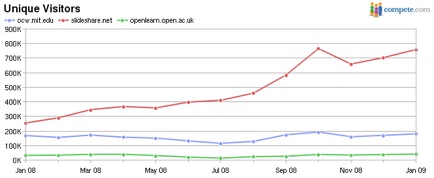
The open education movement is still in its relative infancy, and so if it hasn’t seen the widespread disruption to higher education some had hoped for, we shouldn’t be too surprised. Education as we know it today has had several hundred years to develop the lecture based model, so to expect an open model to radically alter this in just a few years may be expecting too much. There are a number of habits that will take some time to alter, for instance educators are beginning to use a range of third party material in their lectures (Flickr pictures, YouTube videos, OERs, etc), and so the ‘market’ for reusable content is growing. But suggesting that change may come is different from arguing that there is an urgent demand which universities have to meet, or else cease to be relevant. In the OER movement it is probably fair to say that they are leading the thinking and development of concepts around free education, not responding to a social demand.
Lessons from other sectors
The digitisation of content and its distribution via the internet has seen a merging of previously distinct sectors, for instance we see a computer company (Apple) become the main music outlet (iTunes), broadcasters providing telecoms services (eg Sky) and vice versa (British Telecom), and newspapers hosting podcasts (Guardian Online). As higher education institutions seek to explore, and exploit, new technologies, some of this boundary confusion begins to be applicable in the education sector also. For instance, the Open University produces a podcast that features in the iTunes top ten
(
http://www3.open.ac.uk/media/fullstory.aspx?id=11429), Kansas State University Professor Michael Wesch produces YouTube movies that are viewed by millions, and many bloggers having subscription rates to rival those of satellite TV channels (eg
Stephen Downes has over 10,000 hits per day). All of these are outside of traditional academic outputs, ie courses, books and journal articles. The reverse is also true with
YouTube, Google, Sky, and the BBC all engaging in activity that has some bearing on education, and a number of smaller start-up companies (eg TeachThePeople, SchoolForEverything) offering services around informal learning.
The result is that boundaries between sectors are less clear cut, and more permeable than they once were. In addition there are many similarities between education and other sectors, and so one method of analysing the changes necessary, or inevitable in higher education is to look at the changes that have already been made in other sectors, and to gauge whether these are applicable in education. Two related sectors we will examine here are the music industry and newspapers.
The music industry has seen a dramatic impact from the move to digital, online content. Initially sales of CDs were impacted by download purchases, but in 2008 even the inclusion of downloads saw music sales at their lowest since 1985 (IFPI 2009 http://www.ifpi.org/content/library/DMR2009.pdf). Online digital sales now account for 20% of the global market, up from 15% in 2007. User behaviour is changing also, with single track downloads far more popular than whole albums. The move to online downloading has seen many record and DVD stores close (for example, the Zavvi chain in the UK). Piracy is the major threat to the music industry’s traditional business model, with the IFPI estimating unauthorised file-sharing at over
40 billion files in 2008 accounting for around 95 per cent of downloaded music tracks. Calls to make ISPs responsible for policing downloads have met with limited success.
In addition we have seen artists exploring business models which essentially disintermediate the record company, for example Radiohead offered their album In Rainbows, as a direct download from their website, and Madonna signed with a concert promoter rather than a record company.
However, although the underlying models may be changing, the overall relevance and desire for music has not changed (and may have increased with mobile devices). As Rolling Stone reports ‘people are listening to at least as much music as ever. Consumers have bought more than 100 million iPods since their November 2001 introduction, and the touring business is thriving, earning a record $437 million last
year.’
(http://www.rollingstone.com/news/story/15137581/the_record_industrys_decline/3)
Newspapers are seeing a similar change wrought by the internet and digitisation of their business. They have been impacted on by two complementary factors (outside of the impact of the recession generally): loss of advertising revenue and decreasing circulation. The advertising revenue has been lost to many online sites, for example in the UK Trinity Mirror reported a 20.1% fall in underlying group advertising revenues
since the end of June 2008. (http://www.guardian.co.uk/media/2008/nov/13/trinitymirror-advertising), the New York Times reported a similar drop (http://uk.reuters.com/article/ousiv/idUKTRE4BN39Q20081224). Some of this can be attributed to the impact of the financial crisis, particularly on housing advertising, but it is part of a longer term trend. Papers have seen much of their advertising revenue move to specialised online sites, for example craigslist in the US, has well over double the traffic of New York Times, and considerably more than the Guardian Online, as this graph from Alexa.com illustrates:
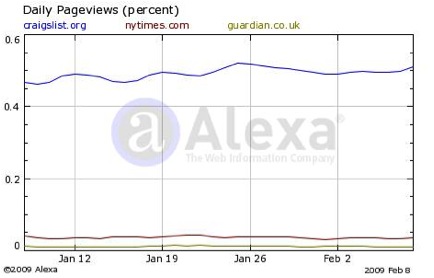
What this illustrates is that newspapers are beginning to see an unbundling of their component elements. In addition the advent of the internet means that people now get their news from many different places, and much of it online. In the US the circulation of the top 25 newspapers has declined on average by 7.4% over the 2005- 2008 period (http://www.bizzyblog.com/2008/05/01/newspaper-industry-circ-downdoobie-doo-down-down-with-four-exceptions/).
Newspapers have failed to make paid-for subscription models work online for example the NYT closed it TimesSelect model in 2007 (http://www.nytimes.com/2007/09/18/business/media/18times.html?_r=2&hp=&adxnnl=1&oref=slogin&adxnnlx=1190632192-61ebx/UKcB7bCMSviuM2Jw) as readers can find the content free elsewhere, and have an expectation that it will be free.
Newspapers and the music business have essentially seen an unbundling of separate services previously contained within the physical product, including the production of content, adverts, packaging, distribution, and the filtering of information. However, before we accept these as direct corollaries for what will happen in education, there are some significant differences between education and these industries, as well as significant similarities.
There is no evidence as yet, that there is a similar expectation from learners that educational content should be free. This is partly because the common perception of education is the lecture, and this is not perceived as ‘content’ in the same sense that an MP3 is. The rapid unbundling of components we have seen in other industries has not been as apparent in education. This can, in part, be attributed to the award-bearing
powers being restricted by legislation, so it is not a free market in the same sense as other industries. There is also the relationship with the physical campus for many universities – purely distance education universities are still relatively rare and so there is a strong link with the physical model that is not found with the content industries.
One could view the components in these various industries as analogous to atoms in a molecule – the strength of the various bonds will vary, and for some molecules these can be easily broken under certain conditions, while others require more energy to break apart. As with chemistry we should not think that all sectors are equal, the ‘bonds’ in some sectors will be weaker than in others. The award-bearing powers,
social currency of universities, and the physical aspect means that the bonds in higher education can be regarded as stronger than in the music industry, but nevertheless they are not unbreakable. This bundling of services could be subject to change, for instance, if accreditation powers were unbundled from universities, and thus the bonds between the components could be weakened.
Conclusions from the evidence
In this paper several contributing factors to the claim that higher education needs to undergo a radical change have been examined. We can look at each of these and state the overall strength of each argument:
- A new generation is behaving fundamentally differently – there seems little real evidence beyond the rhetoric that the net generation is in some way different from its predecessors as a result of having been exposed to digital technologies. There is some moderate evidence that they may have different attitudes. Strength: Weak.
- There is a general change in society which has relevance for learning – certainly the overall context is an ICT rich one, and people are using the internet for a variety of learning related activities. Strength: Strong
- People are learning in different ways – although firm evidence of informal learning is difficult to gather, there is much by the way of proxy activity that indicates this is the case. Strength: Medium
- There is growing dissatisfaction with current practice in higher education – there seems little strong evidence for this. Probably more significant to the culture of education has been the shift to perceiving the student as a customer. There is certainly little evidence that the dissatisfaction is greater than it used to be, but what may be significant is that there are now viable alternatives for learners. Universities have lost their monopoly on learning, which reinforces the next point. Strength: Weak
- Higher education will undergo similar change to that in other sectors – there are some similarities between higher education and other sectors such as the newspaper and music industries, but the differences are probably more significant. However, the blurring of boundaries between sectors and the viability of self-directed, community based learning means that the competition is now more complex. Strength: Medium
It is possible, and at times tempting, to see these complementary factors as some kind of ‘perfect storm’ brewing for change in higher education. It is convenient for many of us who seek to implement change in higher education (for a variety of reasons) to portray it is an inevitable force that cannot be resisted. This may account for why the net generation literature has been so widely accepted – it creates a convenient backdrop against which to paint the need for radical change.Having reviewed the evidence the claims for a perfect storm seem to be exaggerated, but there is a gathering of significant trends, which higher education should seek to address.
Undoubtedly the proclamations of the imminent demise of higher education are overblown – even if it did nothing it would not see the rapid change in its practice that we have seen in other sectors. Rather we should see the response to these trends as having two main arguments:
Maintaining relevance – whilst the strong claims for the loss of relevance of higher education are not justified, we do see some significant factors above, and just as higher education responds to any significant cultural change, so it should respond to these.
Opportunities – rather than portraying the digital culture as an impending threat to higher education, the only option being to adapt or die, it is more fruitful I suggest to think of it as an unprecedented series of opportunities. The manner in which we have taught has often been restricted by physical factors,
and the removal of many of these should liberate both how and what we teach.
The appropriate response
One possible conclusion from this might be that we should be less enthusiastic in our promotion of new technology, until we have the firm evidence that it is required or necessary. I think this is to misinterpret the role of educators in general, and educational technologists in particular. The role of the educational technologist is to interpret these trends and frame opportunities.
There are several reasons why it is still important to engage with new technology, even if the urgent ‘survival of higher education isn’t one of them. The first is that there is lag between technology’s acceptance of a technology and then its adoption in higher education. Brown (ibid) suggests that in society the stages of technology diffusion can be defined as critical mass (ownership by 20–30% of the population), ubiquity (30–70%), and finally invisibility (more than 70%). If higher education were to wait for the invisibility stage to be reached before it engaged with a technology, then given the time it takes to implement policies and technology, it really will look outdated. For example, in 2007, those using social networks might have been in the minority, now they will be in the majority. This is the problem with waiting for data to determine decisions – if you made a decision based on 2007 data that social networks were largely unused, it would look out of date in 2009. What is significant is surely the direction of travel, not the absolute percentages at any given time.
Part of the role of education is to give students relevant skills and by using a range of technologies for academic (rather than purely social) purposes, it could be argued that it is fulfilling this remit for the graduates who will then enter the workplace.
The second reason why we need to continue to engage with technology relates to pedagogy. Part of the role of educators, and educational technologists in particular, is to assess which of these technologies will be significant, both in terms of students lives (therefore they represent a means of us reaching out) but also educationally, therefore providing a means of utilising technology to improve education. This is what many do already, for example the Horizon report (http://www.nmc.org/pdf/2009-Horizon-Report.pdf). The wiki is a good example, we shouldn’t be using wikis because we believe we have a Wikipedia generation and it will make us look relevant, but rather we because they allow us to achieve certain goals in teaching.
The next reason is that if technology isn’t itself the cause for revolution, it is the enabler for maintaining relevance in a competitive market. If we look at the reasons students select universities, we can see these are varied. When it comes to choosing a university, it seems that course suitability, academic reputation, job prospects, and teaching quality are the main factors influencing prospective students (Soutar &
Turner 2002). Non-academic factors also play an important part including proximity to their homes, availability of scholarships and teaching, the range of non-academic student services (Drewes and Michael 2006). Students from low-income families will be influenced by financial factors, such as cost of living in the university locality and employment prospects (Callender and Jackson 2008). It is notable that ‘technology usage’ is not listed amongst these. Students don’t choose a university based on the particular VLE it deploys, but the use of new technologies will have a direct impact on many of these other factors. For instance the range of courses and student satisfaction will be influenced by the deployment of innovative
technology by educators.
The final reason is that of exploration and professional reinvention. The reason educational technology seems more prevalent and indeed, urgent, now is that we live in an age when the quantity of tools that can be put to a pedagogic use is at an unprecedented level and the rate of release of these is increasing. Just as significantly, many of these tools are free and easy to use. Thus their adoption carries a much lower risk than with previous generations of technology. The opportunities for experimentation and finding new ways of teaching a subject are therefore much richer, and given the ease of use, greatly democratised. It is this technology-enhanced enthusiasm for exploring new methods of teaching that educational technologists
should be promoting.
Conclusion
After his meditations Descartes re-established his world view, but this time, he felt, on a much sounder basis. I have not returned to quite the same point that I started from, in that some of my beliefs that higher education needed to undergo radical change have been shifted. But, like Descartes, the beliefs I hold now seem more robust.
The evidence for radical and imminent revolution in higher education may not be as strong as I once liked to believe, but we shouldn’t ignore the fact also that there are some very significant trends which are founded in data and research and not just anecdote and rhetoric. These suggest very strongly that engagement with new technologies is a core practice for higher education. And more significantly, these trends indicate that we have a richer environment in which to explore changes in teaching and learning practice. We have a convergence of a base level of technological competence, an expectation of the use of ICTs in education, a range of easy to use tools, and models from other sectors to investigate. So while the absolute necessity for radical change is overstated, there are unprecedented opportunities for the use of technology in education. And as educators we shouldn’t need to wait until the case has been proven for each one to try it, because as the saying goes, it doesn’t take a whole day to recognise sunshine.
References
Bennett, S., Maton, K. & Kervin, L. (2008) The ‘digital natives’ debate: A critical review of the evidence, British Journal of Educational Technology. Vol 39 No 5 2008
775–786
British Library (2008) Information behaviour of the researcher of the future.
http://www.bl.uk/news/pdf/googlegen.pdf
Brown M (2009) The NetGens 2.0: Clouds on the Horizon. EDUCAUSE Review, vol. 44, no. 1 (January/February 2009): 66–67.
http://connect.educause.edu/Library/EDUCAUSE+Review/TheNetGens20CloudsontheHo/47939
Callender, C & Jackson J (2008) ‘Does the fear of debt constrain choice of university and subject of study?’ Studies in Higher Education Vol 33 No 4
Carson S (2005) 2005 Program Evaluation Findings Report. MIT OpenCourseWare.
http://ocw.mit.edu/ans7870/global/05_Prog_Eval_Report_Final.pdf
Czerniewicz, L. & Brown, C. (2008) ‘A Virtual Wheel of Fortune? Enablers and Constraints of ICTs in higher education in South Africa’, in: S. Marshall, W. Kinuthia & W. Taylor (Eds) Bridging the knowledge divide: Educational technology for development Information Age Publishing.
Descartes, R. (1641) Meditations on First Philosophy
Drewes T & Michael C (2006) ’How do students choose a university?: an analysis of applications to universities in Ontario, Canada’. Research in Higher Education. Vol 47 No 7
Ghosh R and Glott R (2005) FLOSSPOLS: Skills Survey Interim Report http://flosspols.org/deliverables/D10HTML/FLOSSPOLS-D10-skills%20survey_interim_report-revision-FINAL.html
Ghosh, R. A.; Glott, R.; Krieger, B.; Robles, G. (2002): Free/Libre and Open Source Software: Survey and Study. Part IV: Survey of Developers. Maastricht: International Institute of Infonomics / Merit.
Griffiths, M. (2008) ‘Changing Media Environments Are Providing an Alternative Space for Young People to Meet Up’ paper presented at ‘Creating Second Lives’ conference, Bangor, Wales.
http://nieci.bangor.ac.uk/conf/?q=en/content/changing_media_environments_are_providing_an_alternative_space_for_young_people_to_meet_up_m
Grunwald, P (2003) "Key Technology Trends: Excerpts from New Survey Research Findings," Exploring the Digital Generation, Educational Technology, U.S. Department of Education, Washington, D.C., September 23-24, 2003.
Hartman, J., Moskal, P & Dziuban C (2005) ‘Preparing the Academy of Today for the Learner of Tomorrow’ In Educating the Net Generation. Oblinger, D & Oblinger J (eds) Educause.
http://www.educause.edu/Resources/EducatingtheNetGeneratio/PreparingtheAcademyofTodayfort/6062
Lenhart, A., Arafeh, S., Smith, A. & MacGill (2008) Writing, Technology and Teens Pew Internet and American Life Project
http://pewinternet.org/pdfs/PIP_Writing_Report_FINAL3.pdf
Livingstone S and Bober M (2005) UK Children Go Online: Final Report. LSE
http://www.lse.ac.uk/collections/children-go-online/
McAndrew P and Dos Santos, A (2008) Learning from OpenLearn Research Report 2006-2008.
Oblinger D & Oblinger J (2005) Is it Age or IT: First Steps Towards Understanding the Net Generation. In Educating the Net Generation. Oblinger, D & Oblinger J (eds) Educause.
http://www.educause.edu/Resources/EducatingtheNetGeneration/IsItAgeorITFirstStepsTowardUnd/6058
OCLC (2007) Sharing, Privacy and Trust in Our Networked World. http://www.oclc.org/reports/sharing/default.htm
OECD (2007) Giving Knowledge for Free: The Emergence of Open Educational Resources. http://www.oecd.org/dataoecd/35/7/38654317.pdf
Prensky, M (2001) Digital natives, digital immigrants. On the Horizon Vol. 9 No. 5,
October 2001. http://www.marcprensky.com/writing/Prensky%20-%20Digital%20Natives,%20Digital%20Immigrants%20-%20Part1.pdf
Roberts, G (2005) Technology and Learning Expectations of the Net Generation. In Educating the Net Generation. Oblinger, D & Oblinger J (eds) Educause.
http://www.educause.edu/Resources/EducatingtheNetGeneration/TechnologyandLearningExpectati/6056
Seely-Brown, J "New Learning Environments in the 21st Century: Exploring the Edge," Forum Futures 2006 (Cambridge, Massachusetts: Forum for the Future of Higher Education, 2006). http://www.educause.edu/ir/library/pdf/ff0604S.pdf
Soutar G.N. & Turner J.P. (2002) ‘Students' preferences for university: a conjoint analysis’ The International Journal of Educational Management, Vol 16, No 1, pp. 40-45
Weller M (2009) Using learning environments as a metaphor for educational change.
On the Horizon, 17(3).
Weller, M and Dalziel J (2009) ‘Bridging the gap between web 2.0 and higher education’ in Handbook of Research on Social Software and Developing Community Ontologies. Hatzipanagos, S & Warburton, S (eds) IGI Global.
Windham, C (2005) ‘The Student’s Perspective’. In Educating the Net Generation. Oblinger, D & Oblinger J (eds) Educause. http://www.educause.edu/6061&bhcp=1