« August 2007 | Main | October 2007 »

Twitter potential

Okay, having done a negative, now on to the positives of using Twitter.

The social/professional mix is intriguing. People will post links and quotes, but also comments about their hotel room. I follow Scott Leslie, D'Arcy Norman and Brian Lamb, so feel as though I was almost present at the Open Education conference. I have found some good sites through people such as Guy Kawasaki (who I am convinced never sleeps, or is in fact an artificial intelligence program). I have also used it for work, sending someone a message who I saw was online and was supposed to be in a virtual meeting with.

But I've been struggling to get my voice right. I'm happy with Facebook status updates, I get the right tone, but I'm not sure whether I should be posting social chat stuff (I'm off to the cinema), or professional stuff ('Interesting post here') or self-promotion ('New blog post'). It turns out that it's all three probably, as Chris Brogan says in this interview. As with blogging, it's taken a while but I feel as though I'm finding the affordance of the medium now.

Which leaves the question - why? Particularly if not many people are hearing what I say anyway. For me it's about the potential. Next year I would like to get all my students to sign up, so they have this constant low-level contact which is much less intrusive than IM. I think it will be an excellent back-channel around the content. I would also like to see it used institutionally - if there was an OU twitter, it would provide a great knowledge sharing and social bonding mechanism. I'm perservering then, in the hope these come to pass.

So if you're not on Twitter, give it a try, I'll follow you. And if you tried it a while ago and gave up, give it another go, we can follow each other. You can follow me here: http://twitter.com/mweller 

Twitter - elitist?

I've been using twitter for the past couple of weeks, so thought I'd post some thoughts on it. The next one will be positive (see AJ, I'm keeping my posts short), but in this one I'll look at the negatives.

My big issue with Twitter is that it's not symmetrical in the way it forms relationships. In Facebook, if I make you my friend, then I am automatically your friend as well, ie we see each other's profile, so it's a mutual trust and respect. This is not the case in Twitter. I can follow you, but you are under no obligation to follow me.

The result of this is that I follow people who aren't following me, and so while I can see their tweets, they don't see mine. Far from feeling part of a global conversation one is left with the feeling of being outside the party. And rather than being democratic, it seems rather elitist to me - it is hot amongst the real neterati because we get to hear all their thoughts while they don't have to listen to the unwashed (although bless Scoble, if you follow him, he automatically follows you). It ends up being more akin to traditional broadcast than one based around dialogue.

Reflections on the distributed blog experiment

Having set up a distributed blog article this week, and just concluded it I thought I'd reflect on the process.

Overall I thought it worked well, in that it got at some interesting points and covered some different perspectives.

Some negatives:

  • It will be hard for a reader to read it as a whole. I will try and formulate it into a real article for publication somewhere.
  • The time pressure (which I created) meant that you didn't have sufficient time to always get the references you wanted, or to check it through as thoroughly as you might, or to redraft it.
  • They were long posts. Alan Cann has said that he found them too long for blog posts and I noticed David Warlick today offering the general advice "write short blogs.  I can’t tell you how many good blog articles I’ve missed, simply  because, as I pull it up, I decide instantly, I do not have the time to read this right now." I have to say I'd find it a shame if I felt restricted from writing long posts, I value the diversity in the blogosphere, but maybe the medium isn't right.

The positives:

  • It worked! There are a lot of empty wikis and blog experiments out there, so by structuring this one and creating a definite timetable we were able to get something completed.
  • Being open sharpens writing. Of course I coul have done this with Ray, Patrick and Will in Google docs, but there is something about being public in the process that a) makes you do it since I have told everyone that you will and b) makes you produce a good first draft.
  • It has brought in other contributions. Through comments and links from other blogs the overall article has been enriched.
  • It generated some traffic - David Weinberger blogged it so what more can I ask?

So would I do it again? Sure, why not, what have I got to lose but my reputation. Next time though I'd do really long posts.

Future of content - Conclusions

This is the conclusion to the Future of Content distributed article:

In Part 1 I argued that content would move towards being free and widely available, from an economic and quality argument.

In Part 2, Ray Corrigan argued that in fact online content gave new types power and control to large institutions and they would have the weight of the law behind them to prevent the open access I outlined.

In Part 3 Patrick McAndrew focused on education, and the openlearn project specifically and examined the motivations for universities to give away content, and what this meant for the university business model. He also warned that free, open content may generally be thought of as a desirable aim but it might mean we lose some things we cherish currently.

In Part 4  Will Woods takes a technical perspective and argues that there are nine influencing trends now which will see a move towards more, but not necessarily all, content being free.

(There is also my response to Ray's post, Ray's response to me, my response to Patrick, and Ray's response to Patrick - phew!)

In conclusion then, the changes wrought by the digitisation of content and its distribution via the net are the biggest challenge facing those who work in content industries now. They are faced with two choices essentially:

i) Find ways of maintaining the publisher model, by managing the rights and use of content through a combination of technological and legal controls.

ii) Find new business models that give away content but build and sell services around it.

The struggle between these two modes of operating will define content industries over the next five years I would suggest.

Let us take an example of broadcast content. Making high quality content is not easy or cheap, so although the web 2.0 world sees everyone become a broadcaster and the mass become the media, the type of content that can be produced is limited to an extent. Wikipedia has demonstrated that mass distribution of process can work with content as it has with software, but it is difficult to imagine how a high quality television series (think historical drama such as Rome) could be produced for free, by distributed individuals. It might therefore be argued that high quality content will become more valuable, not less. If the first option is chosen then a few television providers have the quality content, which is paid for on a subscription basis.

However, although the web 2.0 content cannot compete on quality it can compete on diversity and quantity. This sets up competition for user/viewer time and attention. The viewer has a choice - do I spend the next half an hour watching Rome or do I listen to a podcast about a subject I am really interested in, watch a couple of inventive YouTube clips and read a blog posting by Stephen Fry (actually the last one will take all of the thirty minutes)? If watching Rome costs me money then the second option becomes more attractive. So, if the second option is chosen, the broadcasters decide to make their content freely available (now you can watch it on YouTube while reading the Stephen Fry post), and they make their money through advertising, sponsorship, or through providing the broadband you are using to watch it.

It seems that there are competing pressures in society currently, which Stewart Brand identified all those years ago:

"On the one hand information wants to be expensive, because it's so valuable. The right information in the right place just changes your life. On the other hand, information wants to be free, because the cost of getting it out is getting lower and lower all the time. So you have these two fighting against each other."

In content businesses now we see this conflict in the development of increasing control through the legal and technical frameworks that Ray has set out, and at the same time there is a massive movement to widely distributed, freely available content. It may be that this is a struggle that is never finally resolved, but instead revisited regularly.

A couple of Gaping Void goodies

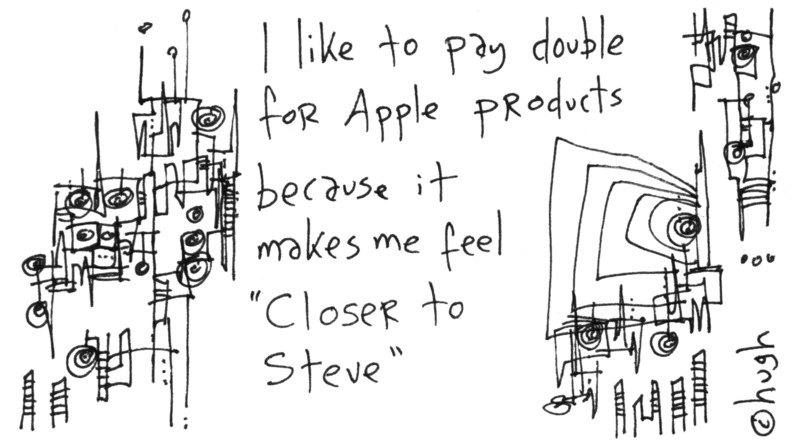
I liked these two from Hugh MacLeod recently. The first will resonate with all my Apple fan friends:

0709closertosteve

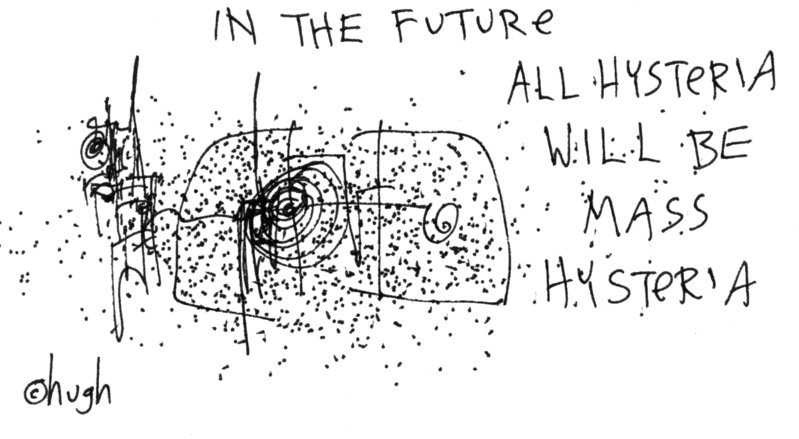
And this one seems true of everything from the McCann case to children's vaccinations:

0709allhysteria

Future of content - part 3

Patrick McAndrew has posted part 3 of our distributed debate. It's a personal case study based on his experience with the openlearn project. Below are my observations on it.

On the motivation for openlearn:

Some of those reasons are complex, but underneath it I think there are two principles one altruistic and one more selfish:

Altruistic reason for open content: there is more value in having the world see this resource than if we store it away or try to sell it

Selfish reason for open content: if we don’t do it someone else will, and then what are we left with

Obviously altruism is great, but ultimately I think it's unsustainable. My arguments about content becoming free weren't based on an altruistic, utopian view, but just on what I think will happen as a consequence of content being digital and online. So although Patrick labels it a selfish reason, it could be termed a realistic reason also - this is what is happening and we need to understand it and find alternative income streams, or ways of competing in this world before it's too late to change. 

Deciding that content itself might not be what you should value could lead to a fresher model of how to work, and help match behaviour to suit the changing times. [At this point I should provide a wonderful analogy in terms of some past industry that changed or failed to change (such as the rat fur traders of old London Town who failed to pay attention to who was getting the blame for the Plague) but I will leave that for the world or your imagination to supply one that is not made up!]

The encyclopedia business is a good one. Britannica ignored Encarta, and almost overnight disappeared, largely because they were focused on keeping their sales employees happy, and too rooted in the tradition of their product. They were right that a complete set of Britannica is a nicer thing to own than a CD from Microsoft, but they were wrong that the motivation to buy Britannica would remain, which was usually 'it's for your children'. Encarta was good enough for the kids and Britannica's model collapsed. 

This seems to be becoming the new conventionalism and social actions (nearly wrote socialism but that would not do) are seen as the be all and end all: community is king. Actually while content is not king, it is not nothing. Similarly while community is important it is not everything to everybody. I find myself here having to switch my own arguments from the need to build as little content as possible to one where the content can feed in from all directions. We are in a more connected world and the connections can be social but they can also be independent, what I believe that should not be is unnecessarily protected.

I know what Patrick means here, and readers may know I like using the 'content may not be everything, but that doesn't mean it's nothing' line. While arguing that content will become free doesn't mean that I think it is unimportant, just that it's economic value is decreasing. And for all my admiration of Facebook et al, I'm not always social, and just going through content independently is what I want to do.

I would like to add a warning though that a free and open world is not necessarily entirely Utopian. The confusing impact of Internet economics and global sharing means we need to watch out that we do not lose things we value along the way to openness

He's spot on here - both Ray and Patrick have termed my view utopian, but it wasn't meant to be. If you work in a content industry it's positively dystopian. The pay for content model is quite simple, but just how money is made in the 2.0 world is not entirely clear. It may be a more ruthless world, with no time or spare capacity for some of the luxuries we enjoy now (such as academics blogging)

How do I? video search

Tony Hirst has created a neat little search interface using Google's Coop customizable search engine. It searches a number of video archives to find instructional videos - he seeds it with the phrase 'How do I?'  He explains it here, so I won't bother, and thus save myself potential embarrassment by getting it wrong.

I will say it returned some very good results for me. I put in a search for How do I.. create a podcast. And the resources it came back with were great. Having just written a piece on podcasting for a course, this reinforces to me the point that increasingly there is little point in me writing guides or even finding resources - students can do much better themselves and find the ones they want. This doesn't make me totally redundant though (my mortgage lender will be pleased to hear), I think my role then is to place podcasts in an academic context by creating meaningful activities and perhaps producing other material which relates to pedagogy, broadcasting, or whatever - ie to make some links to material they might not get through such means. This is a good thing - educators should concentrate on what they do best, not writing how to guides or acting as a search engine.

Tony says he knocked it up in twenty minutes. This also demonstrates the difference in approach in the web 2.0 world 'out there' and the academic world. You just know if this was a university (any university) project it would have been funded for a year, they'd set up careful consultation, draw up a set of user specifications, run some workshops, produce a report, start coding, get to a demo stage that worked only on a very small subset of video, then disband.

Anyway, give it a go.

Future of content - Pt 2 response

Ray Corrigan has responded to my first piece on the Future of Content over on his blog. His is an excellent article, reminding us of the influence of big corporations and setting out the reasons why my view might not come to pass. I recommend reading it all.

For now, here are my responses to some of the points he makes.

"Barlow's meme has often been taken to mean that we should rely on technology and geography and NOT laws, judges or politicians, to protect freedom of speech. Well government censorship of the Net in places like Saudi Arabia and large responsibility for fingering journalists for arrest in China have provided stark indications of totalitarian governments' ability to incorporate the existence of such technologies into their operations.”

But equally they have really struggled to control information. Sure they’ve tried and had some success but this has had more to do with the immaturity of communication technologies, not the increasing ability of governments to censor information. The general trend is towards more freedom of information and as mobile devices and broadcasting/networking equipment become more powerful this will only increase.

"John Naughton tells a wonderful story in his book, A Brief History of the Future, about when Paul Baran wanted to build a packet switching network in the 1960s. Jack Osterman, a senior executive at AT&T, the telecommunications monopolist in the US at the time, said "First, it can’t possibly work, and if it did, damned if we are going to allow the creation of a competitor to ourselves." Look at that word "allow". If the network owners control the networks, who uses them and how they get to use them then the network owners have a veto on innovation, which is the story told by Larry Lessig in the Future of Ideas”

And just look at where AT & T are now – this example demonstrates to me about a company trying to impose old world views on a new world. They just didn’t get it, so it’s not that they could allow, but that they thought they had the right because that’s what they were used to. But users just went elsewhere. This rather backs up Gilmore’s law to me, not undermines it.

"And unfortunately for those who would like content to be free the most powerful actors in the decision making process surrounding the deployment and regulation of the networks that will distribute the content are those who want it to support their profit margins.”

Sure the respective industries want to control it, but the point is they can’t anymore. This is because technologically they’ll always be beaten, and also because the online world allows new market players who will offer an alternative, often a free one. They have to adapt or die – look at photography: Kodak might have wanted to control the print process but ultimately digital cameras and Flickr meant they couldn’t.

"As Lessig says, the content industries, wielding law and technology, have fought a bitter counterrevolution against Napster, DeCSS, CPHack, My.MP3, Grokster, Eldred et al and won, at least in the courts, every time. Though millions of copyrighted works are still circulating online it is an increasingly risky business to engage in such infringement with industrial scale operations the content companies now have in place monitoring this activity and targetting [tens of thousands] of people for legal action.”

This is key to me – you could predict that they would do this. They will always seek to preserve the status quo if that is where their current business model lies. But ultimately the ability to bypass the very need for such industries will mean that all their restrictive DRM will only make them weaker because people will have better alternatives elsewhere. Once the online MP3 and iTunes becomes the main place and format people use to obtain records, the very point of a record company becomes obsolete. So whether they have restrictive DRM and savage lawyers becomes irrelevant, they will be disintermediated. It then becomes in their interest to be open, to seek alternative revenue streams, for example giving music away free but selling merchandise and promoting concerts.

"The architecture of the Internet or cyberspace is programmed in the code, the logical layer and protocols that determine how it operates …The Net - an entirely artificially created entity”

This is true, but it doesn’t mean it’s an entirely controllable or predictable entity. I heard Robert Cailliau, a colleague of Tim Berners-Lee, once argue that we were reaching the edges of our understanding of the complexity in the net. He joked that maybe it was using us to get built. Just as artificial life simulations are artificially created they can still produce patterns and activity that are entirely unpredictable, so the net is better viewed as an ecosystem than a piece of code that can be tweaked to make it do what you want.

Which brings me to Tim O'Reilly's Piracy is Progressive Taxation, and Other Thoughts on the Evolution of Online Distribution which offers six lessons for the media revolution which though outlined in the relative ancient history of 2002 still, I think, hold true today:

Lesson 1: Obscurity is a far greater threat to authors and creative artists than piracy.

Lesson 2: Piracy is progressive taxation

Lesson 3: Customers want to do the right thing, if they can.

Lesson 4: Shoplifting is a bigger threat than piracy.

Lesson 5: File sharing networks don't threaten book, music, or film publishing. They threaten existing publishers.

Lesson 6: "Free" is eventually replaced by a higher-quality paid service

Lesson 7: There's more than one way to do it.

The key ones in the current context being lesson 5, 6 and 7.”

Thanks for adding these in – I meant to in my post and forgot. For me, I’d say it was 1 and 5. 1 is similar to Shirky’s second law – it implies that creators would rather give content away than have it locked down and be obscure. Given the choice between fame and fortune, fame wins. And 5 is exactly right – they threaten existing publishers who will fight to stop them – but they’ll lose.

Tim O'Reilly: "The question then, is not the death of book publishing, music publishing, or film production, but rather one of who will be the publishers”

I’d agree with this and conclude that increasingly ‘we’ are the publishers and as such ‘we’ don’t have the vested interest in controlling rights, because of Shirky’s second law.

Though Adam Smith and Garrett Hardin [Tragedy of the Commons] might dispute the notion that individual participants in Web 2.0 activities, unlike Dawkin's selfish gene, would behave in the best interests of the system as a whole thereby speeding the evolutionary process)”

I knew a natural selection analogy was always a bit dangerous and open to misinterpretation, but just to clarify. The reason I say it speeds the evolutionary process is that natural selection doesn’t have sight of the overall objective, it isn’t an intelligent entity making decisions. Whereas people producing content obviously are, so you don’t have to wait for random changes to make improvements. My recourse to natural selection was to demonstrate that massive distribution can produce amazing complexity, indeed is probably the best way to get complexity. The more obvious analogy is with software production, where the top-down proprietary (read Microsoft) approach is struggling now against the distributed open source approach in producing complex, robust software.

The new morning routine

I have a morning routine now, which has evolved over the past year or so. It's remarkably different from even a couple of years ago, largely as a result of becoming a blogger I think. Here it is:

After the school run I sit at the laptop with a cup of tea and bowl of muesli (if I'm indulging - marmite on toast).

  1. Firstly, I check email, delete all the spam messages, do any quick responses, and mark any more detailed ones for later.
  2. I check messages in the student forum for the course I run.
  3. So far, so 1990s. Next I go to my blog, check stats, and comments and respond on any comments.
  4. Then I pop in to Facebook, check my news feed, update status and look at any messages or notifications.
  5. By this time Twitteroo is loaded so I catch up on all the tweets from the US or Canada of the people I am following. I follow any urls that have been twitted and look interesting.
  6. Lastly, to Google Reader to look at any new blog posts of the 112 blogs I subscribe to. I will scan most of these, ignore a few, read some, and respond to maybe one or two.
  7. Now I'm ready to start work.

And here's some thought on what this routine reveals:

  • It's a mixture of social and professional. Most of my Facebook friends, blogs and Tweeters are professional peers but what they post is often a mix of social updates and relevant resources.
  • I'm more connected to what is happening in my field than I was before. I didn't used to start every day by reading an academic journal, but I will usually find one academically interesting post or resource before I've finished my cup of tea.
  • It's expanding. Since being a blogger I have had the additional burden/privilege of tending one's own blog garden, but also I have become a much more active blog reader, so now have a lot of posts to get through in my aggregator. And then I added Facebook in to the mix, and more recently Twitter. I don't seem to have dropped anything though. At this rate my morning routine will be my all day routine.
  • I'm developing new skills in scanning, interpreting, reading and writing. Given the expansionist desires of my morning routine, I have developed further skills in information processing - I'm not on a par with ultra bloggers, but I can scan my Google reader list quickly, and determine which posts to follow. It may not be always reliable, but it is reliable enough. I know how to get in to Facebook, get what I want and get out quickly. I am currently trying to develop my Twitter voice (more on this in a later post).

Any other activities that should form part of a connected morning routine?

The future of content -Pt 1

[Note - this is part of a distributed article, see previous post for explanation]

The Future of Content

In this section I am going to argue that digital content will move toward being free and widely available because of two complementary arguments: the argument from economics and the argument from quality.

The argument from economics

Where content can be digitised, it is having a profound effect on the economics that underlie the business model of that content, and the way society uses and thinks about it. In this opening section I want to look at two examples of how the digitisation of content has led to significant changes in a number of industries.

Newspapers

Many newspapers ignored the online world for too long, assuming their customers would want their news that way. Now that they have been forced to shift all of their content online, they are finding new business models to cope with this. The initial hope was that essentially the same model would apply, that people would pay for content. But the pay per copy, micropayment and subscription model have all failed. Most recently the New York Times closed its TimesSelect subscription business and made its content free. Apart from it not making enough money, the reason seems to be that the subscription model harmed the alternative model of advertising, which is driven by the global audience finding their content.

Vivian Schiller of The Times comments “What wasn’t anticipated was the explosion in how much of our traffic would be generated by Google, by Yahoo … our projections for growth on that paid subscriber base were low, compared to the growth of online advertising”. In other words, it is better to be free to all of the market than paid for by a small section.

Music

Another example of the massive changes wrought in an industry by the digitisation of content is the music industry, which like newspapers was slow, and resistant, to change. The wake-up call for the music industry was Napster, when suddenly millions of users were exchanging songs and albums without paying. This was partly a result of wanting to have something for free, but it was also because Napster facilitated behaviour which was the content discovery and the social function of music. Through Napster users could find other bands that were similar, sample different types of music, find other users with similar tastes and, most importantly, do all this from their laptop.

Eventually, iTunes saw the industry find a model that seemed to suit both parties. Users could download individual tracks at relatively low cost, and also engage in the content discovery through shared playlists.

LastFm and Pandora take this social aspect a stage further, by data mining users actions to build up a network of artists, so that you only need enter an artist’s name and be able to have a personalised radio station playing similar tracks. You can also find users with similar tastes, join groups, see upcoming events, etc. You can’t own music through these sites and you can’t request a specific album, but when the richness of the choice becomes so great, maybe that becomes less significant. And meanwhile the file sharing software is back, with applications such as Limewire allowing users to share files again.

The internet has also changed the relationship of the recording artist to the record companies. Increasingly bands are establishing an online presence, allowing free downloads of their music to build a following, touring, and recording an album, and only then seeking a label. Even this last stage will become redundant once CDs finally disappear. As Chris Anderson puts it in the Long Tail

“At this point, the artists don't need the labels any more. The consumers don't need the labels any more and I think the labels, rather than trying to protect what business they have, need to ask themselves what is their relevance."

Changing our relationship to content

I’ve concentrated just on two of the more obvious examples here, but there are many more. For instance, where audio goes, video will follow once the bandwidth is sufficient. So for traditional television broadcast we are seeing subscription models becoming increasingly difficult to maintain. This has been partly affected by the BitTorrent type sharing services that allow the download of large AV files. At the moment this remains something of a technical skill, but as it becomes more viable and easier, then DVDs will go the way of CDs.

As well as changing the underlying economics of the industry, it alters the way we relate to the original product. To return to music again, in Everything is Miscellaneous, David Weinberger suggests that digitisation of content has altered our perceptions of what we thought was the basic unit of musical output:

"For decades we've been buying albums. We thought it was for artistic reasons, but it was really because the economics of the physical world required it: Bundling songs into long-playing albums lowered the production, marketing, and distribution costs ... As soon as music went digital, we learned that the natural unit of music is the track."

Nick Carr disagrees with Weinberger, stating the artistic structure of the album, using Exile on Main Street as an example but Clay Shirky argues that if this were so, then it would survive digitisation. When you look on iTunes this is not borne out - most people download Tumbling Dice.

Digitisation has made the track the currency, and then users have begun to create their own playlists by mixing tracks together. In addition, attendance at concerts and festivals is on the increase – people will pay for the live event, but less so for the content that supports it. Digitisation has changed our relationship to music, artists and record companies. Forever.

Shirky’s Second Law and the Content Law

In 2003 Clay Shirky wrote an article called Fame vs Fortune: Micropayments and Free Content, in which he argued that micropayments (which he defined as "payments of between a quarter and a fraction of a penny,”) would fail. At the time there was considerable interest, and belief, in micropayments as a model for internet enterprise. He said of the failed attempts of micropayments that “they failed because the trend towards freely offered content is an epochal change, to which micropayments are a pointless response.” Whereas analogue publishing has inherent costs, essentially the cost of the format, storage and transportation, digital publishing doesn’t. The cost involved then is that of the creators, and online the creator can become the publisher. They will then be faced with a dilemma, Shirky argues, of fame or fortune. In an analogue publishing world you could have both, since in order to achieve fame lots of people need to have read your book, or bought your album. If online people are resistant to paying then charging for your content limits your fame potential. As he puts it in a follow up posting in 2007, creators are “in the position of having to decide between going for audience size (fame) or restricting and charging for access (fortune), and that the desire for fame, no longer tempered by reproduction costs, would generally win out.”

We’ll call this Shirky’s second law (the first is generally given as “Diversity plus freedom of choice creates inequality”, a precursor to the long tail), that is given the choice between fame and fortune, fame wins out.

This, combined with what we have seen above led me to propose the content law, which I think embodies what will happen to content in the future:

"Digital content wants to be free, and will seek the path to maximum access."

In their book Blown to Bits, Evans and Wurster argued that the digital marketplace has seen the unbundling of the economics of information and physical product. This is most readily seen in retail, where you have to see the physical object in a shop to know about it, but online the product information is separated out. David Weinberger explores the implications of this unbundling further, in that it allows infinite recategorisation because the information, unlike the physical product, can be in multiple places at once.

Let’s consider a possible future example, that of books. When the web first became popular there were some suggestions that books would disappear since we could download free ones. This did not come to pass for a number of reasons:

1. Transportability – books are easy to carry about, and don’t run out of battery life, can be used on a train and don’t require a special device.

2. Ease of use – books don’t require special help programmes, can be used by most of the population, have good navigation features and are good at presenting text, compared with the small screens of some hand held devices.

3. Cultural value – we cherish books as social artifacts. Few things cause as much outrage amongst civilised people as seeing books being burnt or desecrated. People have a deep affection towards the tactile nature of a book.

For these reasons, and combined with the advanced content discovery facilitated by Amazon and co, book sales have done very well since the arrival of the net. But let us consider what would happen if digital paper really arrived (despite several proclamations digital ink and paper have been stubbornly difficult to realise, but that isn’t the point of my argument). It felt like real paper, you could have it bound in books like real paper, you could write on it like real paper. But crucially the content it displayed could change, you could search it, and it could record all those annotations you made.

Even as something of a bibliophile, this begins to look tempting to me. I like having books as objects on my shelves, but I used to like having vinyl albums and CDs also, but now I only have MP3s (and clear shelves). If digital paper were so good it overcame the 3 benefits of books above, then it would have significant advantages over real paper.

What would the book publishing industry look like then? I would suggest that Shirky’s Second Law and the Content Law would take over. What would be the role of publishers? If you can download a copy of book into your digital paper book, then a good deal of what the publisher does disappears. They don’t need to provide the printing, binding, or distribution. What they can provide is the marketing. But this is where Shirky’s second law becomes relevant – some authors will start to give their content away cheaply (since unless you’re JK Rowling, most of the cost of a book goes to the retailer and publisher to cover all the costs associated with analogue format). As an author you may only get 10% and have to do most of the work, so why not sell it for that and generate interest online? Then another author decides that actually what they’ll do is give their book away free, because that way people link to it, quote from it, mash it up with Google map overlays, or whatever. Being free and open generates a lot more traffic.

For the industry as a whole the content law is now in operation. Books are now digital content that wants to be free and to have the maximum audience. Publishers need to find a new business model and relevance or they disappear.

As George Siemens puts it "Consumers, like learners will in the future, have a dramatically different relationship with content than they have had in the past. Textbook publishers, journals, and other content-centric industries need to take heed of these lessons and adjust before they become the next statistic.”

The argument from quality

The argument I have given above suggests that economics will be the main driving factor in the liberation of content and has focused on individuals or small groups creating content. A second factor is that it will improve the quality of a lot of content through the distribution of the process.

Here we have a powerful analogy in the process of natural selection which shows us that a vastly distributed process can produce things of great complexity. As Daniel Dennett argues in Darwin’s Dangerous Idea, Darwin’s great contribution was to remove the need for top down intervention (or sky hooks in his metaphor) in any explanation of how biological complexity is achieved:

"Cranes can do the lifting work our imaginary skyhooks might do, and they do it in an honest, non-question-begging fashion… Skyhooks are miraculous lifters, unsupported and insupportable. Cranes are no less excellent as lifters, and they have the decided advantage of being real.” (pg 75).

The blind, but distributed process of natural selection was sufficient to do all the ‘lifting’ required in biological design space. Natural selection is distributed over many individuals in a species and over a very long time span. This allows for small, but incremental changes to produce cumulative complexity. The internet allows for similar distribution across individuals, but unlike natural selection, each participant is not dumb, or blind, to the process, thus the overall process is speeded up considerably, and we don’t have to wait millions of years for the results.

What the internet, and web 2.0 in particular, achieves is this massive distribution of the task. Just as prior to Darwin there was no way of conceiving of biological complexity without some designer, without top-down input, so many of the web 2.0 critics fail to understand how you can achieve the relevant sophistication required for, an encyclopaedia say, without a heavily controlled, centralised, top-down process. The democratisation of process that web 2.0 has wrought is key to understanding why they are wrong.

Take photography as an example. There are a lot of people out there who are quite good photographers, some of whom are ignorant of the very specialist skills required, but who have a natural talent, others who have some knowledge, and others still who are specialist in certain types of photography. They were all largely ignorant though of the process required to become professional photographers, of how to share their photographs when the sharing is controlled by the economics of distribution and a top down authority. With the advent of Flickr all of these people can now share their photographs. The result is an explosion of creativity, and real, undeniable high quality photographs.

What the web 2.0 critics would say is that if you compare any photographer at random from Flickr with any random professional photographer then the second will win out, because they have been through the filtering process. But this is to fundamentally misunderstand the nature of the distributed process that is now in place. Sure, if you pick any photographer at random on Flickr then you probably find very average family snaps, but the result of the process as a whole is the production of islands of complexity. And what is more, because the traditional filtering process in the top-down model tends to make professional opinion converge, what you get from the bottom up process is a far greater range of inventiveness and style. In evolutionary terms, the first process is like inter-breeding while the second is akin to broadening the gene pool.

This is what critics such as Andrew Keen fail to appreciate in their criticism of web 2.0 and user generated content. It is not the comparison of any one individual with another, or any one artefact, that is significant, but comparison between the processes. And when it comes to producing complexity, mass distribution wins every time.

So the second reason why content will become free is that only by removing it from behind the confines of payment and strict rights control, can certain types of content be improved. We have seen this in software of course with open source, and with general knowledge in wikipedia, but it also occurs on a smaller basis with blog posts, podcasts, etc where the overall product is improved by making it open, and then incorporating user comments and feedback.

[Over to Ray Corrigan for the second part of this]