
« March 2008 | Main | May 2008 »

When Reorgs strike

Chairs

Chairs in boats by Stuck in Customs http://flickr.com/photos/stuckincustoms/216810101/

I work in the Institute of Educational Technology at the OU, where we've recently had a review. The result is something of a reorganisation. There are good and bad elements to it, as always. I'm not going to go into the review itself, but rather reorganisations in general. Reorgs were a feature of the early PC industry, partly I think to demonstrate that these type of companies were more fluid and dynamic than the highly structured, rigid companies that had come before them, e.g. Apple vs IBM.

Reorgs weren't always productive though. In his book, 'Insanely Great' about the development of the Mac, Steven Levy argues that the constant reorgs at Apple were one of the reasons Apple struggled to follow up on the initial success of the Mac (this was back in the 80s). One could take a 'Social Life of Information' perspective and argue that through reorgs a lot of that informal, socially bound knowledge that is required for organisations to function is lost, or at least disrupted.

So, at one extreme excessive reorganisation destroys some of social fabric that holds an organisation together. But I wonder if in higher education we are too much at the opposite end. I remember a colleague arguing that far from have too many reorgs, we don't have enough. This allows people to think that the way things are structured now is the only way it can be. Artificial divides build up between disciplines, people tend to work with the same crowd, and there is sedimentation around process and ideas. I accept that there are a host of other issues that surround reorgs, for instance job security, identity, the time and cost involved and one's sense of professionalism, but if these are satisfied, then I think there may be something in what my colleague was saying.

So maybe a reorg every 5 years or so should be standard, and we could have faculties such as 'Social Sciences and Mechanical Engineering', 'Computing and History' and 'Sports Science and Mathematics'.

Actually, I think that with new ways of connecting, it's not that the reorg should be more prevalent, but rather that organisational structures, which are often physical organisational structures, are increasingly irrelevant. My OU network is as much to do with my OU Twitter network as it is to do with my 'formal' placement in a group, which is in an Institute. I think it is addressing how we nurture, manage and support these kinds of structures that will be the next challenge rather than finding ways of slicing the cake differently.

Or put another way, in Weinberger's term reorgs are about filtering on the way in, we need to find ways of filtering on the way out.
Broadcast Strategy Review - my screencast

I was involved in the Broadcast Strategy Review at the Open University. We produced a website as the output (not a 100 page report!), most of which is for internal viewing only. I've taken my bit though, and uploaded it to Blip.tv. I am talking here specifically about how the changes in broadcast affect OU academics, but most of what I say applies across the board. My aim was to emphasise how the changing nature of broadcast is an exciting opportunity for educators. Unfortunately, even at its most excitable pitch my voice has all the enthusiasm of Clement Freud on valium, but as Billy Bragg said 'in a perfect world we'd all sing in tune/but this is reality so give me some room.'

Here it is (ignore the text at the end, that applies to the OU site):

Adblock

PS - Blip.TV was much better than YouTube for this. For a start the audio didn't work in YouTube, and the text from screenshots is just awful.

FlatWorld Knowledge - the publisher I've been waiting for?

David Wiley is part of a startup called FlatWorld Knowledge. Their aim is to release digital textbooks free of charge, with students paying for the print copy if they want. What is more interesting though is the way they take the notion of the text book and make it more of a social object. So the educator can edit the book for their class, the student can interact with other students around it, and people can sell related services and content. In fact, when you view their little cartoons it makes you realise just how limited the traditional text book model is in education. Why didn't we do this years ago?

From my point of view, I have a book proposal and want a publisher. I am currently with Routledge, but they have a traditional attitude to publishing, they wouldn't even let me put a couple of chapters up on this blog. So what I want is a publisher who will allow me to give away the digital version, but still charge for the print version. So I contacted FlatEarth, but it seems that at the moment they're just focusing on Business books, as they're in startup mode. Makes sense I suppose, but it means I'll either have to find another publisher or wait for them to open up their portfolio a bit. Does anyone know a publisher who isn't living in the dark ages?

Crowdstatus and filtered twitter

Crowd

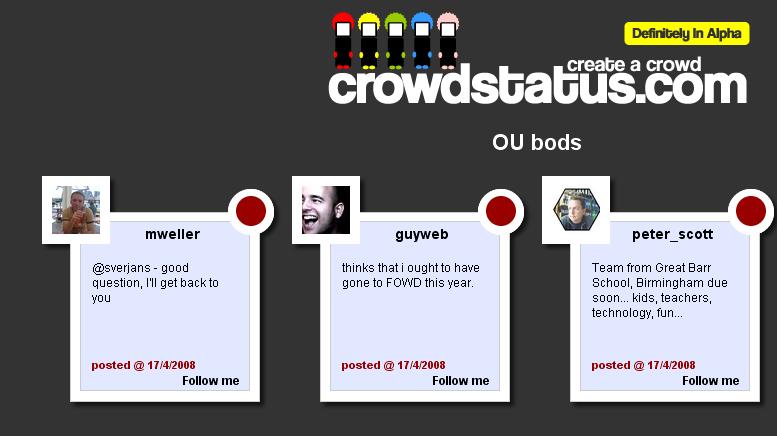
In my Twitter stream I saw that Dan Taylor had created a crowdstatus page for BBC people. Crowdstatus basically takes public Twitter streams and compiles them on a page with some nice graphics. I had a go and did the same for OU people I know on Twitter (if I've missed anyone off, let me know, or if in fact you're not an OU person and I've put you in).

Firstly, a couple of things in crowdstatus I'd like: the ability for anyone to move the order around; automatic refreshing; can anyone join a crowd, or can only the originator add them in?; the option to have most recent updates near the top; an RSS link; an iGoogle plug in (that's it for now).

Next on to the broader aspects. I like this because subsumed in my Twitter followers are a number of different networks. Even within my OU people there are OU Staff, IET, Students, etc as sub-networks. So it is good to be able to filter these. And this then really opens up the potential for community building or even (whisper it) knowledge management by Twitter.

For example, you get all your students to sign up to Twitter and then create a crowdstatus page for them. You can see how this filter of other Twitterers and aggregation in one space adds a social/peer working element to the course which could be quite powerful. And when the course has ended, it still persists (or goes in to the course alumni crowdstatus page).

Another example, everyone I work with in IET signs up to Twitter, and I create a crowdstatus for them. Then when we move into our swanky new open-plan office building, the wall mounted networked screens display the crowdstatus page. When you're making a cup of tea then you will notice that X is in a conference in Valencia, Y is struggling to write a JISC bid and Z is mowing the lawn. By osmosis almost you would have a better understanding of what your colleagues are up to and interested in than any number of scheduled meetings. It's the future of organisational dialogue I tell you!

Inward and outward facing technology

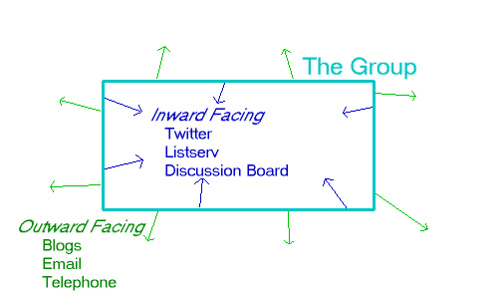
Stephen Downes recently argued that we could classify communication as inward and outward facing, saying:

a technology like Twitter is, in my mind, 'inward facing', because it reinforces communication with the group - 'running with the herd,' as I commented on Noon's post, while I tend to favour 'outward facing' communications, those that look outside the group.

And he has this diagram to sum it up:

Twitterinward_2

http://www.flickr.com/photos/stephen_downes/2379258809/

I'm not sure I agree with this analysis, as I think it comes down to your usage of the tools. Here is my reasoning:

  1. I don't think many of us are outward facing in terms of the blogs we read. For instance, my GReader doesn't have many subscriptions to intelligent design blogs, or pregnancy, or snowboarding blogs, because these aren't things I'm particularly interested in. The blogs I subscribe to tend to be educational technology ones. So in terms of what I read blogs are no more outward facing than Twitter.
  2. I could argue Twitter is outward facing since I tend to adopt a 'I'll follow you if you follow me' strategy. Thus potentially I am exposed to different types of people than I might be through the blogs I read. This would be even more the case if I were one of those people who followed 1000s of people in Twitter.
  3. I accept that writing a blog is more akin to broadcast while Twittering is more akin to conversation, but even that distinction is blurred if you consider linking and commenting in blogs (which make them more like conversation) and the posting of links in Twitter. One could argue that because it is less effort to Twitter then people are more likely to post links to a range of things, not just those related to the subject area. In this respect then, Twitter becomes more outward facing.
  4. The social interaction on Twitter adds a different element, which you don't always get on blogs. This means that, again, you may discuss topics or be pointed at resources which are outside of the group's normal discussion.

I'm not arguing one is better than the other, just that I don't feel the inward and outward facing distinction is appropriate to my use of the tools. Or maybe I've misunderstood what Stephen was saying - if so, just shout Stephen!

With protection like this...

Just in case any of you haven't read David Wiley's reaction and follow up to the story that a publisher (Faulkner Press) and a lecturer are claiming that student lecture notes infringe his copyright, you should do so. Instead of just shaking his head in disbelief, as I would have done, David does some digging and finds this jaw-dropping quote on the publisher's page about the lawsuit (called, now get this 'The Future of Higher Ed'):

in this lawsuit Faulkner Press is proud to protect the rights of Professor Moulton and the rights of all professors.

Of course, the 'rights' of students aren't a concern here. David also enters into an email debate with the publishers, in which the publisher says:

I’m not familiar with your views on IP in general,

It's David Wiley!

but if you hold that a professor’s lecture is in the public domain, such that any third party may make as much money on that IP as the market will yield, then we disagree.

Well, a professor's lecture can be in the public domain, but that doesn't mean a third party can make money from it - here's a thought, maybe they could use a Creative Commons Non-Commercial licence? It's the being in the public domain that really bothers the publishers, because for this read 'then the reason to buy his books will be diminished and we will make less money.'

It's clear that these publishers, who are no different from any others I suspect, simply don't get it. Actually they don't get lots of its: they don't get that as an educator you want students to have as much access to your stuff as possible because it helps them learn; they don't get that books come off the back of our subject knowledge which is funded by students to start with, not the other way round; and they don't even get that by putting stuff out there you might actually sell more books.

It seems clear that in claiming to defend our rights, publishers really do think we educators just don't understand IP. The idea that you might want to give stuff away just does not make any sense to them. I am reminded of Clay Shirky's phrase when talking about open source support to AT&T guys, 'it was if we said we get our Thursdays from a banana'. Increasingly publishers and educators are talking different languages here, and the real danger for publishers is that one day all educators will realise that they don't really need them. If they think that taking strong legal action like this is the way to protect their business, then they should bear in mind it's exactly what record companies did when they first hit the download problem. And look where they are now...

Twittershow - I don't know if I want it but it's fun

Tony has gone all mashup in the head and developed an app for Twitter that takes your (or someone else's) tweets and presents them as a slideshow, called Twittershow. I've had a play with it - I think this link will take you to my tweets as a slideshow.

To use it you need the RSS url of your Twitter feed - to find this,  go to your public Twitter page (e.g. http://twitter.com/mweller). At the bottom is a link that says RSS - this then gives you a page with a URL like this: http://twitter.com/statuses/user_timeline/7127162.rss

Slot this into Twittershow and away you go. Doing it made me laugh, because I'm convinced that for all the careful preparation I put in to my presentations, it would be just as meaningful if I just stuck up my, or someone else's tweets and talked around them. That aside though, I still don't get when I would actually use it, but I'm often slow on this kind of thing. What it does evidence though is that openness releases creativity - I'm pretty sure an app to do presentations would never have come up on the functional spec of a closed Twitter system, but release the API (and of course, release the data through RSS), and look what happens. Sure, it may be pointless, but then again it may be something really cool...

An eduglu learning scenario

I was part of an ad hoc Flashmeeting recently with David Wiley's team, plus some of the edugluers (Jim, Brian, D'Arcy and Scott), along with the OU social:learners (Tony, Simon, Patrick and Stuart). We batted some ideas around about the idea of eduglu, loosely coupled apps, open courses, etc. There was lots of common ground, but we don't want to tie it up in consortium or anything - so we're going to work in the open, in a loosely coupled manner. And of course, anyone else is free to join.

We agreed to come up with some stories, or scenarios, as to what it might be like for a learner in eduglu land. This is my attempt at doing one:

Character: Ellen is a professional vet, living in Wales. She is married, with a four year old son, and is a fan of 60s sci-fi movies and is a keen skier.

Scenario: Ellen is called out to look at a sick Pot Bellied Pig. She is unsure of the symptoms, but thinks she has a diagnosis. She uses her mobile device to put out a call for help on her learner network. This is built on top of Twitter and allows her to filter tweets to groups, e.g. 'vets', 'parents', 'friends', etc. Dan, from Sussex is an expert in Pot Bellied pigs and confirms her diagnosis, sending her a link to a resource. She saves this to her study list in her learner profile, with the tags 'vet', 'pigs', and studying it is automatically added to her To Do list in Remember the Milk, so she will study it later.

Back home she gets a prompt to watch a programme on skiing on BBC 4, which is generated by an automatic tweetscan and schedule scan she has set up with filters. She won't watch it live, but a link to the replay in iPlayer is automatically added to her To Study list, with the tag ski.

This is part of a content aggregator that finds content related to the learning goals Ellen has set up. Her current goals/interests are "To learn snowboarding", "60s Sci-Fi movies", "Blue Tongue virus", "Teaching children French" and "Harry Potter novels". Content related to each of these is found using data-mining, and social recommendations, building on 43Things. Recommended resources are then attached to each goal, with a score, and a category, e.g. 'video', 'book', 'person', 'course', etc. Ellen sees that there is a weekend snowboarding course running at the dome in Milton Keynes. She sees that one of her skiing contacts has taken the course and sends her a message asking about it.

She is doing an 'informal course' on 50s/60s Sci-Fi movies, created by an enthusiast in Oregon. The course is delivered through his blog, and is free to study. Today, having watched 'The Day the Earth Stood Still' yesterday, she reads the blog entry on it. She sees that John from Queensland is online at the same time, and they use Gabbly to chat around the topic, which is embedded in the blog. This is the last entry in this course, so she decides to have a go at the end of course quiz, which is delivered via a free MCQ engine. The score is automatically passed back to her profile, as authentication is handled in both by openID.

A suggested task for the course is to create a mash-up, which she has been working on. She has taken clips from Invasion of the BodySnatchers, Them! and The Blob all of which show women screaming, helplessly, and mixed this with a 1950s magazine article about how women should be protected from rock music. This is overdubbed with a PJ Harvey track, which she hopes makes the ironic point clear. She posts this on her blog, with the tag 'DonsSciFi', which means it will be pulled in to the resource pool for the course for future students. This also pulls it into her profile as one of her public outputs, and this action notifies her sci-fi friends via a tweet.

Purpose: I wanted to take some existing tools, and some imagined ones, and show how these could be easily combined for a learner. I also wanted to combine formal and informal learning, professional and private life.

Next: I'm going to try this as a mini-meme. Not because I want to be annoying, but because I think this is a genuine way of building up a set of scenarios that might inform what we want to do. I am keen to explore this open, distributed model of collaboration. So, if you want to be involved, simply write a scenario and link here (I'll do a wiki later). The 'rules' are:

  1. It can be about teaching or learning (or both)
  2. It can be as long or short as you like
  3. Try and link to existing technologies
  4. It's purpose is to show how loosely linked applications could make learning/teaching easy, pedagogically sound and fun.

I'm going to tag Scott next, as I think he has some ideas from the teaching angle. Take it away Scott.

Offsetting some of the dangers of outsourcing

Niall Sclater raises some issues around potential dangers of outsourcing your IT services, picking up on my recent decision to go all things Google. Niall is referring to a talk by Alan Bell and the two particular potential problems he raises are:

1. You tell your students to use a system hosted externally, maybe one which downloads client software to the learners’ machine. A student’s system gets corrupted and they claim that your institution is liable.

2. You use a free externally hosted collaboration system for audio conferencing for a tutorial and a student tells you during the session that they can’t complete an assignment due to a bereavement. You take no note of this and it slips your mind. Because there is no accessible record of the session you’re again opening up your institution to a liability.

I would say the first of these - not really an issue, since most of what we're talking about are web based services anyway. The second might be an issue, and is part of the broader issue of having less direct control. A similar problem might be that a student claims a particular system was down, or the student says they haven't read a message, etc. All of these are verifiable when you have integrated systems with monitoring. I would say that I think monitoring as an excuse to use internal systems is overplayed, since no-one actually uses it much, and you have other tools available, e.g. Google analytics, but let's ignore that for now, and think about how this might be addressed.

The first way would be to decide on core services that you really need to host internally. Assignment handling might be one. I suspect the danger with this approach is that some people would soon argue that everything is a core service.

The second approach is to use reliable third party services who you have some level of partnership, or at least discussion with. So you can at least ask them if their system was down. The danger with this approach is that it would soon be pulled in to the institutional bureaucracy and before you know they would be demanding that Slideshare (or whoever) sign a service level agreement.

The third approach is to spread risk. By having a range of activities and systems, then failure in any one is mitigated as students can do something else. This is a definite advantage over the centralised system as when that goes down, everything is lost.

The fourth factor is to have a light integration touch between institutional systems and third party apps, that can at least offer a degree of monitoring. I'm not sure if institutionally hosted authorisation services would do the trick, but this kind of thing.

And the last approach is probably the most interesting and not related to technology at all. And that is to engage with, and trust, your students more and create more activity based courses. A lot of these 'issues' are only issues when you need to be directing students to do very specific tasks. If one adopts a more research, activity based pedagogy then some (not all) of these issues become legitimate problems for the student to work around.

Whither the blogosphere?

A few prominent bloggers have, of late, been talking about the move away from the blogosphere. For instance, Stowe Boyd says that:

Basically, conversation is moving from a very static and slow form of conversation -- the comments thread on blog posts -- to a more dynamic and fast form of conversation: into the flow in Twitter, Friendfeed, and others. I think this directionality may be like a law of the universe: conversation moves to where is is most social.

So, what are blogs going to be when the conversation moves away? They will be the place where we archive our posts, so that people can find them when they need to search, which still is a necessity.

And Scoble  argues that our digital lives are spreading out:

When I started this blog in 2000 there wasn’t Twitter. Wasn’t Upcoming.org. Wasn’t Google Reader. Wasn’t Flickr. Wasn’t YouTube. Wasn’t Seesmic.

And Hugh MacLeod tweeted this the other day:

Sorry, Gang, I just don't think I can do the "Blogosphere" thing any more. Gonna do something else. Already doing it, actually.

So what's going on here? Firstly, it's interesting to note that these are all active bloggers who have been doing this for years. And they're all self-employed, with lots of contacts. In other words, maybe the blog has done its thing for them. At this stage, it is more about the social networking than establishing a profile around ideas. The relative importance of a blog may depend on who you are and where you are in your career.

Scoble is right though - the blog used to have a monopoly on establishing your online identity. Even when the first wave of web 2.0 apps came along, they were usually to feed into your blog, e.g. YouTube. But now there this very central position of the blog is challenged. You have Twitter, FriendFeed, Flickr, SecondLife, Facebook, etc where you can establish an identity.

Having said that though, I think the blog is more than the archive that Stowe suggests. It is the place where you have more detailed discussions, where you set out coherent (or incoherent) arguments, where you publish work in progress, and where you explore ideas. The need to do this may depend on what you do - for instance in education, I'm struggling to get academics to accept that the blog is a valid form of scholarly activity. I don't think they'd go for the idea of everything being expressed in 140 character Tweets. But that's not to say that the more flow based tools won't augment the type of discussion happening in blogs (and tools such as cocomment could be seen as bridging the gap between the two worlds).

What I think is happening is another example of technology succession. The blog was the primary colonizer for the barren landscape of online identity. The presence of this colonizer changed the environment, which made it more amenable to secondary colonizers, e.g. YouTube, Flickr, Slideshare, etc which relied on the blog to spread. This in turn made the environment even more  friendly towards the social flow apps, which started out linking to blogs, but have gradually taken on their own life. This resulting ecosystem will vary for each of us - for the people above the third wave of colonization has taken over the dominance of the blog and forced it into a smaller ecological niche. For others, the blog is still dominant, but these other tools flourish around it.

There is a hint in some of the comments above that this marginalisation of the blog is inevitable for all of us. I don't think this is so, we help determine that ecosystem, and for many of us the blog still fulfills a very central function, because of the type of communication we engage in.

But if it is inevitable, this shouldn't be taken by those who have resisted my call to blog as proof that it was a waste of time. The truth is that you can only get to the next wave of succession if you've been through the preceding ones.