« April 2008 | Main | June 2008 »

The business of education

Tony outlined some web 2.0 business models the other day. Stephen Downes picked up on this, and commented

"[I] am compelled to think that the disaster that happens when democracy is for sale is nothing compared to what will happen when learning is for sale"


As Tony was thinking about SocialLearn, this is something I've been musing over for a while too. So, I offer this post up in the spirit of debate, because even putting the words business and education in the same sentence is heresy for some, and yet I think we will face some very difficult choices in this area over the coming decade, so we can't ignore it.

I think we should be clear that any Vice Chancellor will already tell you that education is a business. Even if students don't actually pay themselves and are funded by government, freedom of choice as to where they go, effectively creates a market. Lecturers, administrative staff and librarians don't work for free and buildings don't build themselves. Universities are therefore competing for students, and so will offer courses they think are attractive, facilities that are appealing and trade on a brand name. To this extent education is already 'for sale', and it is difficult to see how within current society it will change.

But, the situation is likely to get more complex and if the business aspect is currently hidden then it is will become more explicit. The driving forces behind this change are numerous, here are some candidates:

  • Decreasing Government funding - the model of Government paying for the entire student education has been dwindling since they cut maintenance grants in the UK, and similar trends have been seen globally. With top-up grants and cutting of ELQ funding in the UK we can see a general move towards universities having to become less reliant on subsidy (I'm not saying this is a good thing, just highlighting it as a pressure on Higher Education).
  • Increased competitiveness between universities - the explosion in student numbers during the 1990s saw expansion in higher education institutions. Now that these numbers have levelled off, there is increased competition between these institutions for students.
  • Globalisation - many 'Western' countries specifically target overseas students, who bring in more funding. It is likely that host country universities will fight back against this, moving competition on to a global scale.
  • Increased complexity in the education market - if you are a learner with a specific requirement then universities are no longer your only option. Not only are there commercial organisations who may offer training, but there are a range of other providers who have educational content which may meet your needs, e.g. Sky, BBC, The Guardian, YouTube, OERs, etc.
You may disagree with my list, but I think these are all observable forces and there are probably more. As I've already mentioned, my intention is not to argue that these are benevolent forces, but that we should recognise them and consider how higher education should respond.

I think there are two broad tactics, and then many different interpretations of each. The two main responses can be labelled political and pragmatic (they are not mutually exclusive, you could engage in both). A political response is what I guess Stephen would advocate - these argues that the existing society which creates these pressures is at fault and we should seek to change that. The pragmatic response (which I guess I'd advocate) argues that we should find practical ways of operating within this new environment.

So, to come back to the business models, here are some questions which I genuinely don't know the answers to, but which we may have to find soon.

  1. Is advertising revenue ever acceptable? E.g. would ads run on a university site that provides funds for student services compromise a university.
  2. Is providing free resources and tools, but charging for support and accreditation acceptable?
  3. Would 2) be acceptable if the learner didn't pay, but used Government subsidised 'vouchers'?
  4. Is a model that relies solely on Government funded students viable?
  5. Would charging companies, not individuals, for professional development be acceptable?
  6. If we believe in OERs, how do we find a sustainable model for them that allows educators to be employed while giving away their content?
And there are many more. The point is that technical and social changes are being felt by higher education. Some of this will be good, some will be bad, but we are likely to face some difficult choices, which we should start considering now.


Twitter events


Eurovision_tout

The other day I mentioned that I like to Twitter when I'm watching football on TV. My wife doesn't watch, and if I'm not in a pub, it's a way of sharing the experience. Then on Saturday it was the Eurovision Song Contest. I started to watch it, but put a DVD on, then when I looked at Twitter it was awash with Eurovision comments. It struck me that Eurovision was in many ways the perfect Twitter event. It is, in fact, quite boring (none of the songs are any good), so there is plenty of time to Twitter. At the same time, it is quite enjoyable and provokes comment, so there is a desire to share. And you know that it is a communal event, so others will be watching too.

There's not much broadcasters can do with this, except maybe set up a Twitter id (e.g. Woganesque commentator during Eurovision), but this ability to share the experience online may be the the thing that saves scheduling. Sky Plus and the iPlayer have pretty much destroyed the notion of scheduling, but for programmes and events you want to share, then it has to be done at the allotted time. This obviously applies to live events (sports mainly), but also to any programme people might congregate around. It could be The Apprentice (AJ likes to tweet about this), or Eastenders.

Gapingvoid may have been dismayed by the Brits twittering about Eurovision, but in this respect his talk of social objects is correct. The future of television is not in it being a solitary experience, but in being a social one.

Think of these as 'flash social networks' - Jyri Engestrom argues that "social networks consist of people who are connected by a shared object.” Around TV we may see these social networks form for the duration of a programme and then dissipate. The key challenge for broadcasters is to facilitate this without stamping all over it, or going creepy treehouse on it.

[Update - Darren Waters had beaten me to it on this]

Twitter meltdown?

It's not been a good week for Twitter. Most of Tuesday it seemed to be down, and then most of Wednesday evening too. One comes to expect short outages in Twitter, you almost regard them with affection, that bespeak of its cottage industry status (I guess they've gone to put another dollar in the meter). But these outages have been very frustrating. Last night I was watching the Champions League Final, and I often Twitter with other people who are in that narrow cross section of ed tech/football fans/in my twitter list, so I'm not watching alone. But no luck last night, apart from a few brief windows of opportunity.

The Twitter guys don't seem to know what the problem is. Some Twitter fans have become angry and organised a Twit-Out, a 24 hr boycott of Twitter. The danger for Twitter is if you start using another service, you'll stick with it. There's nothing really in the design of Twitter over Jaiku, Friendfeed, Pownce, etc that makes me use it - it's just that it's where my network is, and I can't migrate without them. But if they started to go, the infamous tipping point might be reached very quickly. The only warning I would add is that if we all migrate to another service, then that will likely have problems too. I'm not techie enough to know what Twitter's problems are (hell, if they don't know, why should I), but I'm guessing it relates to scale. They've become a success-disaster. It's likely the same fate would befall the next micro-blogging service we all jumped too - then we'd go back to Twitter which would now seem reliable.

All this might be grist for the 'stick with institutional services' mill, apart from the fact that there isn't an institutional Twitter and if there was it'd only connect me to people in my institution. Those boundaries have gone, and  we need to find tools that support this. It might also be grist for the 'web 2.0 free business model has burst' mill. There may be something in this - like many people (including one suspects Twitter themselves), I find the business model of Twitter a mystery. Except I don't think these problems are related to money or capacity, ie throwing more money at it wouldn't solve it. They seem to be arising from the complexity of the number of posts and how these are handled. Maybe the solution will require more money, but my feeling is that it hasn't arisen because they lacked investment, ie it could have easily happened to a company with paying customers if they had this type of traffic.

So we'll have to wait and see. What's certain is that this won't be the first of these type of problems for web 2.0 services. This is still relatively new ground in terms of technology and more importantly, user behaviour. And with scale comes unforeseen complexity. And that's the fun of it - we get to see the new paradigms being created.

When is a creepy treehouse a community of practice?

Chris Lott coined the term 'creepy treehouse', and John Krutsch defines it as "a place online that adults built with the intention of luring kids in." Jared Stein has an excellent post on defining a creepy treehouse further:

n. Any institutionally-created, operated, or controlled environment in which participants are lured in either by mimicking pre-existing open or naturally formed environments, or by force, through a system of punishments or rewards.

n. Any system or environment that repulses a target user due to it’s closeness to or representation of an oppressive or overbearing institution.

n. A situation in which an authority figure or an institutional power forces those below him/her into social or quasi-social situations.

None of these commentators is suggesting that we shouldn't exploit new technologies for learning, but rather warning of the way in which you do it, to avoid Creepy Treehouse Syndrome.

I think it's an excellent term, but I have a couple of reservations about it. Firstly, it could be used as a justification for not engaging with any social networking tools in education. You can imagine someone saying 'I've heard students think you're building some kind of creepy treehouse if you go near that stuff. What they want from us is distance, authority and lectures.'

Secondly, it suggests that all learners are young (I know that is explicit in the definition  of luring kids in, but it could be extended to all uses of social networking in education). In the States and many other countries the number of higher education students older than the traditional 18-22 year old range now exceeds those in that range. There may well be different needs and different uses of technology for the adult learner. They don't see it as a creepy treehouse, or even a happy playground, because those are not meaningful metaphors. These are people more concerned with a peer or a professional network.

For instance, I asked all my post-grad students to sign up for Twitter. Some have stuck with it, some haven't, but for me it has changed the dynamics of that educator/student relationship and made it more peer like. I was pleased to see that one of my students, Manish, is now doing the same with his students. I don't see anything creepy about this (of course, the students may disagree!), because of the different nature of learners involved.

Twitter Tales #1

This one starts with Stuart Brown reading the Broadcast Strategy Review, and I remind him there is a website. It then goes on to to prove the adage that 'if man can describe it, Hirst can mash it.'

stuartbrown -  reading the ou broadcast strategy review

mweller -  @stuartbrown - don't you mean 'viewing' (ie the intranet site). Reading is so 1700s

lauradee -   @mweller what if 'viewing' isn't your learning style? :) I'm all about reading... am getting some Paperchase "tattoos for librarians"

nogbad -   @lauradeeDo "tattoos for librarians" say "Shhhhh!"?

lauradee -   @mweller @nogbad they say things like I love books (instead of I love Mum) over pics of hearts, I'd show ya but their website isn't great

nogbad -   @mweller @lauradee I'm sure @psychemedia will do something exciting with Yahoo pipes to show where most librarians have tattoos

psychemedia -   @nogbad @lauradee oh if you insist...... http://tinyurl.com/656wz5  ok?

nogbad -   @psychemedia Awesome! We now know that librarians have tattoos on their shoulders :-)

lauradee -   @psychemedia you are a Geek God

Twitter Tales

I know lots of people don't get Twitter and last week Will accused me of having a Twitter addiction. Part of my response to Will was that as I work at home a lot, Twitter really gives a lot of that peer/professional/social interaction you get at work. I'm not addicted to Twitter, but I might be addicted to my network.

Anyway, I thought I would start collecting series of exchanges on Twitter that over time will show this variety of interaction. So I'm going to start posting 'Twitter Tales' here. My approach is apart from a brief intro to let the tweets do the talking themselves and just list the interchange. I hope that over time I'll have enough Twitter Tales that the next time someone asks me why I do it, I can just point them at my Twitter Tales anthology. I would be interested in hearing other tales too, so blog yours.

One point - all of the exchanges are public, so I won't explicitly ask people's permission to list them here - I'm assuming that's ok?

Mac/Linux users look smug now

Vistarfmoptions

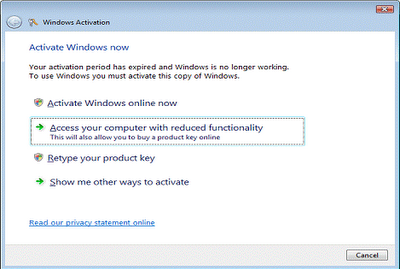
I got a laptop from work last year with Windows Vista installed. I don't use it much (I have a Vaio with XP which works fine), but it has become our media machine at home. Then yesterday it gave the message that the activation period had expired and this version of Windows was not valid. I tried entering the code on the sticker on the machine but no joy. I contacted tech guys at the ou who reckon I will need to plug it into the campus network for it to update. As I'm in Cardiff and in the US next week, this means it's at least a couple of weeks before it will be usable again. I asked if they knew this would happen, and was told no. I wonder if other organizations know about this 'feature' of Vista? I've always been reasonably pragmatic about Windows as an OS, if everyone else uses it, then I'm happy to. But not being able to access a legitimate copy is rather stretching my agnosticism. So finally it may be a case of Linux, here I come.

We're all Canadians now

178563428_96cb29a33a_2

Happy Canada Day by Our Enchanted Garden http://flickr.com/photos/enchantedgarden/178563428/

A tweet from Jennifer Jones the other day made me reflect on the prevalence of Canadians amongst my favourite bloggers/twitterers. In response to Dean Shareski tweeting "Now I've got colleagues saying to me, "Can you ask your twitter network.......?" Ask them yourself! I didn't say that but I should have", Jennifer responded 'Mine say 'ask your Canadian friends'. This is much the same for me - I have a blog rule that goes something like 'if one of the Canadians hasn't blogged it, then it can't be important'.

Here are the Canadian bloggers that form the core of my blogroll:

D'Arcy Norman

Brian Lamb
Scott Leslie
George Siemens
Stephen Downes
Dean Shareski

Then there are the 'Honorary Canadians', those who seem associated with the above, to the extent I probably thought they were Canadian at some point (indeed, since it's often hard to gather info they may well be for all I know):

Alan Levine
Jennifer Jones
Chris Lott
Jim Groom
Jared Stein

This is a semi-serious question: why do Canadians seem to take to blogs and Twitter so well? Is this a genuine observation, or just my perception? Is there something about the environment, education system or culture that might make it so?

I'm not sure Europeans can become honorary Canadians, but Tony would definitely qualify.

Turning to Twitter in a crisis

Jim

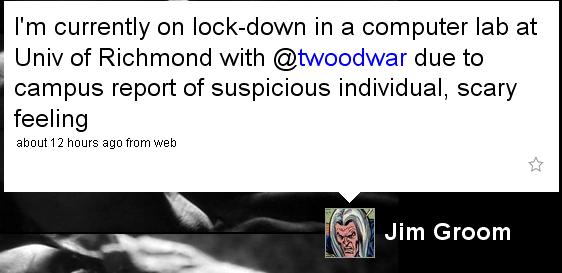
Jim Groom has an amazing account of how a group of people at a presentation at the University of Richmond were suddenly told to turn off the lights and be quiet as a suspicious character with a gun had been spotted on campus.

After the initial moment of fright, he relates how a number of them turned to Twitter, and how this turned out to be both soothing and useful:

"I found the act to be really soothing. People at UR were information and advice to one another, while the larger network from around the world was sending regards, prayers, questions, and their well wishes. I had a very powerful sense that those “others” were there with us from beyond that lab, or even the UR campus. I can’t fully explain why that felt so good, someone even offered a Safety dance from abroad, nothing like laugh during a moment of untold strangeness"

I've wondered about this before - is Twitter only useful or interesting if everything is going okay and it remains fairly frivolous. I'm sure there would be life events that I wouldn't Twitter about, but Jim's experience shows that it isn't just for discussing ed tech or making jokes.

As an aside, following Jim's Twitter stream and that of others at Richmond yesterday (eg Andy Morton), as well as those outside (e.g. Jennifer Jones) begins to look like a new literary form. I await the first Twitter novel with eager anticipation. Maybe we should write it?

PS - I am having a great blog comment discussion with Jim and Scott Leslie over on Jim's blog about No Country for Old Men - I love that this has nothing to do with ed tech.

Web 2.0 - even if we're wrong, we're right

Brian Kelly has a good slidecast talking about exploiting the social aspects of web 2.0.  He gave a similar talk with the title 'Web 2.0 - what if we're wrong?' and in Twitter I tried to argue that even if we're wrong, we're right, but struggled with the 140 character limit, so I'll put my argument here.

Brian makes a good case about avoiding the Gartner Hype Curve where you have rising expectations, which are not met, and then a trough of despair (I can't embed the actual slide direct, but it's slide 19). He is right about this, and the possible risks. Many web 2.0 companies don't have a sustainable business model, and there is undoubtedly some hype amongst all of this. Brian gives a good account of how these risks can be overcome without retreating from the brave new world. His angle is from IT services, but I want to broaden out his argument.

Just as with the initial dot com bubble, the fact that there is hype doesn't mean that the overall direction isn't correct. It may not completely change the world in the next 18 months, but it will significantly change the world in the next 5 years. Ewan McIntosh digs up a great quote from Clifford Stoll in 1995 saying (amongst much pooh-poohing of this internet stuff):

"Then there's cyberbusiness. We're promised instant catalog shopping - just point and click for great deals. We'll order airline tickets over the network, make restaurant reservations and negotiate sales contracts. So how come my local mall does more business in an afternoon than the entire Internet handles in a month?”

Few would doubt we do all of those things online now, and much more. So even if the e-commerce enthusiasts were wrong about the speed and extent of change back then, they were more right than Stoll was in dismissing it.

And that's the case with social networking, web 2.0, user generated content, liberation of content, etc. Even if it doesn't turn out as some enthusiasts predict there is one key point that the detractors always miss - it will never go back to how it was. After wikipedia, Flickr, YouTube, iTunes, etc the idea that consumers of newspapers, books, music, television, and yes, education, will realise it was all just a silly mistake and go back to how it was may be what the industry leaders dream of, but is unlikely, to say the least.

Which brings me on to my even if we're wrong, we're right argument. Sure things won't be the utopian vision of free services, open education and democratisation that some talk of, but whatever comes after the current trends will build on top of them. Just as web 2.0 built on what had happened in the first wave of web development. And the people who got it, the founders and the visionaries weren't people who had dismissed the web and insisted it would go away. They were people who engaged with it, and could see how to take it forward. So, whatever comes after web 2.0 (don't say web 3.0), the people best placed to understand it and adapt to it will be those who have immersed themselves in the current technological climate, and not those who have sat waiting for it to fail so they can say 'told you so.'