« February 2008 | Main | April 2008 »

Meme: Passion Quilt

Webisagreement

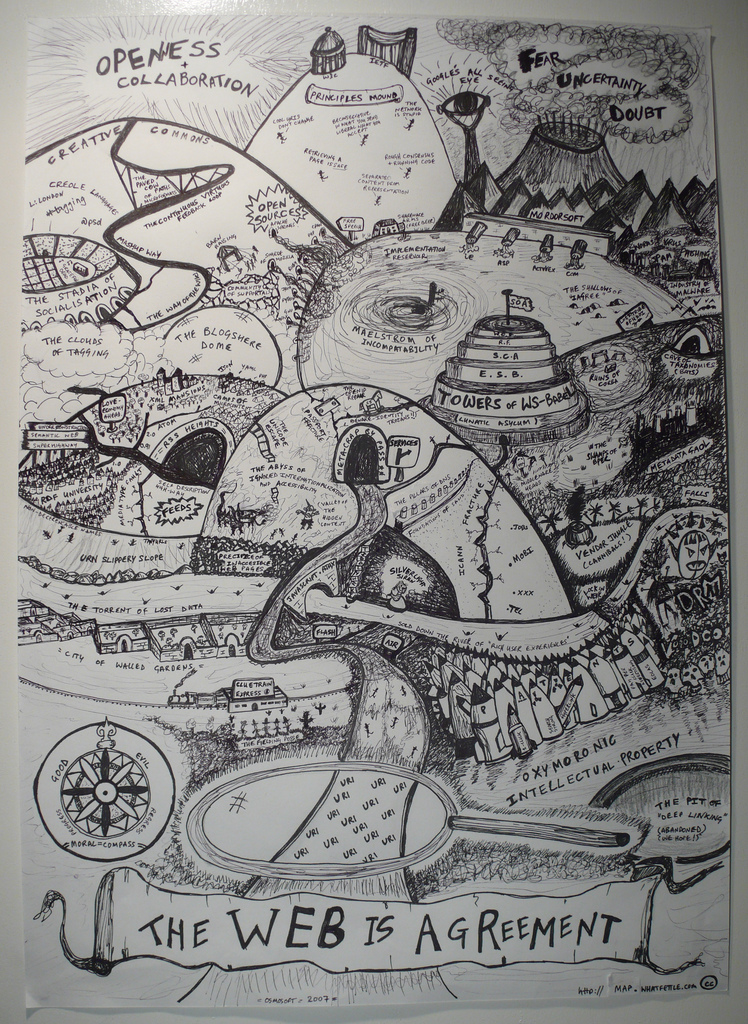
The Web is Agreement by PSD http://flickr.com/photos/psd/1805709102/in/set-72157602805227511/

I'd like to begin this post with the obligatory sentence for starting any posting on a meme, which goes something like 'I don't usually respond to memes, but I thought I'd do this one.' Except this is the first time I've ever been memed, (by John Connell), so I can't.

In the passion quilt you are meant to state what you are passionate about teaching I think. I work at the Open University, and back in 1998 I developed their first fully online course, called You, your computer and the Net. It was an introduction to how computers and the internet worked and also what you could do with them. It was at level 1, which means that anyone should be able to take it. We made the course entirely online, got students to create web pages as assignments, engage in collaborative activities in discussion forums, etc. We were repeatedly told that it wouldn't work at level 1, and that no-one would want to take it. Of course, the demand was unprecedented, with nearly 15,000 students in its first year. Some hated it to be honest, but for many it was a life-changing experience. They found that not only could they understand this technology, but they loved it. And furthermore they loved studying this way. As one student put it, 'I would study You, your garden and your allotment' if it was online. '

So that is what I am passionate about in teaching - taking technologies, removing the fear from them and getting people to see their potential. I run a Masters level course now, so the life changing moment isn't as common, but I still like to try and get students enthused about the potential of technology in education (you won't be surprised that it's Twitter this year).

I chose this web is agreement poster from Paul Downey because it acts as a reminder to me that the easy path is always to the right. The harder path is to go to the left, but the overall goal is greater if one does

As I understand it, I have to now tag five others to carry this on. I'm going to opt for Open University folk, just to give my go a particular flavour.

Tony Hirst

Grainne Conole

Patrick McAndrew

Doug Clow

Ray Corrigan

Here are the rules:

1. Think about what you are passionate about teaching your students.
2. Post a picture from a source like FlickrCC or Flickr Creative Commons or make/take your own that captures what YOU are most passionate about for kids to learn about…and give your picture a short title.
3. Title your blog post “Meme: Passion Quilt” and link back to Miguel Guhlin’s original blog entry.
4. Include links to 5 folks in your professional learning network or blogroll or whom you follow on Twitter/Pownce.

 

Second OU Facebook app - My OU Story

Dsc001951

As you may know a while ago a small Facebook team started up at the OU, to develop some apps and just learn about how you operate in this social networking space for the benefit of students. The Facebook team is Tony with the ideas, Stuart with the user testing, Liam with the coding, me with the... erm, yeah, well it's too complicated to go in to now.

The first app was Course Profiles. This allowed OU students to declare which course they were studying, had studied and were going to study. The interesting thing about this app was the way it could be used to drive other uses, e.g. we could use it as the basis for finding a 'study buddy'.

Liam has now finished the coding on the second app, My OU Story. This allows users to declare their mood relating to their study from a prepopulated list, and to add a 'micro-blog' type comment. It then displays a Mood Graph, showing your mood across the course. It also allows you to send a message to someone e.g. 'Keep going', or my favourite 'Be more modest'. And of course, all these actions show up on your news feed, so others will see it and hopefully respond.

Liam describes some of the techie stuff, Stuart talks about how it could relate to his own learning and Tony gives a good overview.

Tony will no doubt post about the usage, with some of his nice analytics, as it gets adopted. What is interesting for me is that conceiving of applications that make sense in this social networking world may have more significant implications for not only how we develop educational technology but also on what education may look like in a post-wikipedia/Flickr/YouTube world. The differences are quite subtle, and probably obvious, but they may indicate quite fundamental changes. Here are the ones I think may be important:

  • People not content - our applications are aimed at facilitating interaction with other students, not with content. This is not to say content isn't important, and given that it's Facebook one would expect a social emphasis, but the significance of the social element is increased.
  • Facilitation not direction. The applications are aimed at facilitating the interaction between students, which is at their discretion, not on directing student behaviour.
  • Less control - we haven't specified _how_ the applications should be used, students will adopt them and use them for their own means. These are much less formal OU applications, at the moment no course team has made their use compulsory. This much looser system may not be totally scalable, ie there may be some tools that are mandated. But this applies to education also, there may be some 'mandated' content and activities, but also more variation.
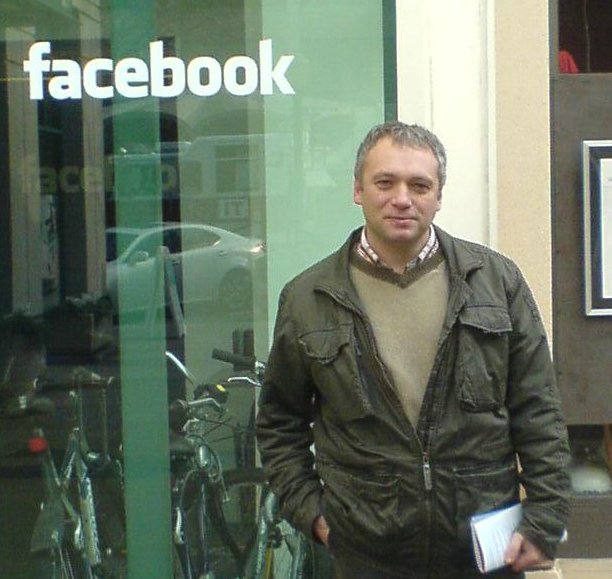
  • Small informal team - the Facebook team, or T.oAD, came about by Tony having some chats with Liam and Stuart. I joined later just to grab some glory, and also to help clear some of their activity higher up in the University. The work doesn't really fit in with many of the conventional management structures, mainly because people do it in their spare time. I was asked how the project was being managed once, and I replied 'by beer', because we tend to meet weekly for a pint and talk things over. I think 'management by beer' will become more of the norm, and institutions will need to find ways of interfacing this with the more conventional structures.

Beer

CogDog's Twitter lifecyle

At the risk of sounding mildly obsessive about Twitter, it was good to see George Siemens blog about his conversion. Alan Levine has created a wiki (back in April 07) where people can plot their Twitter lifecycle which goes from 'that's the dumbest thing' to 'I cannot stop!', complete with a lovely Kathy Sierra homage image. I've added myself in naturally.

More Twitter types

I find the different uses of Twitter fascinating. The complexity of its use derives from its simplicity, people can take it and find their own mode of communication, rather than a specific usage being prescribed by it. So, if we take the over-used (by me anyway) metaphor of an ecosystem of technologies, Twitter is successful because it is highly adaptable, it can occupy different niches in the ecosystem.

In my last post I asked the question whether someone who had lots of followers but didn't follow many was 'misusing' Twitter. I accept 'misuse' was the wrong word, since it implies there is a 'correct' use of Twitter, and of course people are free to use it anyway they like. As Alan Levine says in the comments, one should be wary of rules. What this led me to reflect on though was the various uses people have for Twitter. Over at Read/Write web they suggest three Twitter personalities: Listener (you follow more than follow you), Talker (you have more followers than you follow) and Hub (you have equal followers and followed). Incidentally, I really don't like their 'Twitter score' - the number of followers divided by the number you follow, since this implies it's 'better' not to follow people.

Their three personality types are useful, but it's more complex than this. I've had a go at coming up with some other types of Twitter usage. This is just a way of thinking about how we use Twitter, not implying that people must conform to one of these types (see the point at the end).

  • Twitter as added bonus - Stephen Downes says that he has Twitter followers (who get his Facebook updates), but doesn't follow anyone. I'm one of Stephen's 'followers',  so although I know he doesn't use Twitter much, it's worthwhile following him just as part of my network. Stephen makes the point that he reads over 500 blogs and does lots of commenting/linking, so for him Twitter is a very small part of his ecosystem. It is an added bonus for the followers if they wish.
  • Selective interaction - users with a large number of followers may choose to only follow a few people, but then use the @ reply function for interaction. For instance Will Richardson and David Warlick   both have in excess of 1000 followers, because they are prominent edubloggers. Faced with this, they only follow a few people, but still manage to be active Twitterers, by putting out calls on Twitter, e.g. getting people to say hi to a live audience. Here the asymmetry of Twitter works well, because if anyone does an @ reply to them, they will see it, even if they are not following that user. So this type of user has the added bonus, plus some of the interaction.
  • Small scale social interaction - a lot of my OU colleagues follow each other, some other people they know and not many others. For them Twitter is about maintaining a social interaction with people they know, as Laura puts it, sharing a virtual office with them.
  • Wide peer network - with roughly the same number of followers and followed, these users see Twitter as maintaining a wide peer network, both with people they know in 'real' life and those they have come across through online interaction. If I had to be in a category, then this is probably me. I follow roughly the same number as follow me (although the two are not equal, ie there are some I follow who don't follow me and some who follow me who I don't follow back), and I see Twitter as a means of maintaining a social and professional network with these people.
  • Large scale users - think Scoble, GapingVoid, et al people who have lots of followers, and who also follow large numbers. These differ from the wide peer network in scale and because theirs is a network built up by fame, not just social contacts. They are similar to the added bonus user, but they are also very active in interaction.
  • Listeners - as the Read/Write post suggests, there are people who prefer to follow lots of others, but don't really want to post themselves. They see Twitter as being rather like a blog reader, it's another way of staying up with their subject area.

And if it needs stressing - all of these are 'valid' uses of Twitter, in the same way 'lurkers', 'active posters' etc. were valid uses of forums (remember how people used to agonise over lurkers?). What is also interesting is that you can vary within one user. For example, I am generally a wide peer network kind of user, but I also have a small scale social interaction subset, and the type of post I put up may vary depending on this.  So perhaps this is really a classification of Twitter uses, rather than users.

It's just you

(via MLx) I love this - one of the founders of Twitter has created a service that allows you to check whether a service is down. It asks the simple question 'Is X down for everyone or just me?'

Down

And then let's you know:

Down2_2

This saves you asking the question on Twitter, and often of, Twitter.

Twitter etiquette

My general practice in twitter is to follow someone if they follow me, although not if they appear to be a bot, spammer, non-poster or nutter.  So I have around 140 people following me, and I follow 136. There may come a time when I have to revisit this policy - I couldn't follow 1000 people say, or rather if I did, the value of Twitter would start to diminish for me because I would miss too much from the people I like.

Twitterq

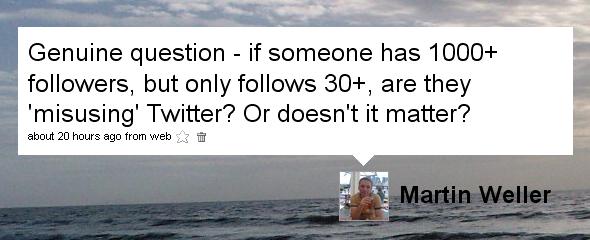
But people use Twitter differently, and I noticed one person I follow has over 1,000 followers but only follows around 35. So, I asked the question, is this a misuse of twitter, or doesn't it matter? The general consensus was that it doesn't matter. I think this is right, and misuse was probably the wrong term. After all those 1000+ followers are getting something from following that person. But it does illustrate how people think of Twitter differently - for me it's a dialogue, but this is using it more as a broadcast tool, rather like blogging.

Laura picks up on this, saying:

I’m at a a stage of my Twitter life where I am wondering how many people I can follow. It’s not quite a mid-life crisis but at 30 something (following) it’s already a struggle to keep up with all the good leads.

Which again gets at how people perceive Twitter. I don't feel that I need to read the tweets of everyone I follow. It's a dip-in, take a scoop from the passing river kind of experience. So in that sense it's not like dialogue - I don't interact with everything, and can dip out for long periods.

Erm, that's it, no real conclusion, just interesting to observe how something as simple as Twitter can have so many different uses and interpretations placed upon it.

Everything is Miscellaneous workshop

I did a session at the OU yesterday on Weinberger's Everything is Miscellaneous. Below is the slidecast. The audio is a bit quiet, I know I should redo it, but time presses on, so apologies if you have to turn it up loud.

Aristocracy, leaders and communities

Ewan started something of a ding dong with his post on why bottom up alone doesn't work in communities. The comments (building on my previous post) are worth reading here, so take a look. I appreciate Ewan's thinking out in the open approach, my instinct is for bottom-up approaches, but I've had a mild rethink after reading this piece.

Firstly, let's get the A word out of the way. Ewan talked of an aristocracy, using Jimmy Wales' term. Stephen Downes took umbrage with this. I accept that Ewan wasn't defending the 'real' aristocracy, but rather arguing that communities require a degree of top-down input to form. Nevertheless, I still think aristocracy is the wrong term, since as a metaphor it fails. Successful online communities (whether they have a top down element or are purely bottom up) are nearly always highly democratic in nature. Anyone can gain status and recognition in them by virtue of the contribution they give to the community. This is exactly what doesn't happen in an aristocracy - no matter how hard you work, you can never join an aristocracy.

Now on to the question of leaders and authority. In the comments I argued that it was 'natural' for people with more authority to emerge in a community. I am using the term authority in the technorati sense here, not the police officer sense. So there are people whose opinion is generally given credence, and respected, because of the value they have given to the community. They have authority in that respect. But they do not have authority in a 'go an do this' sense.

The example I used was the edublogosphere (okay I didn't look very far). Stephen and Ewan (again, not looking far) both have authority in this sense, because they are well respected, have a good readership, etc. If you asked members of the edublogging community to suggest some blogs, their names would come up regularly. So, (and Stephen would probably hate the idea), they are 'leaders' in the sense that they are representative examples of edubloggers. But they are definitely not leaders in the sense that they can control the community, or that the community relies on them. The blogosphere is interesting because it is also very personal - although overall Stephen and Ewan (and others) have status, for any individual those who might be termed leaders will be different. For instance, for bloggers at the Open University, Tony Hirst probably has equal or higher status than these two, because his blog is directly relevant to them.

So, while leaders, or let us call them 'more prototypical members of the community' may emerge, that does not mean they are the founders of the community, or that they are necessary for the community to exist. This is true however for some communities. Open source software projects comes to mind - the Linux community couldn't have existed without Linus Torvalds, since he started the project and his input was necessary to get the community established. It could probably exist without him now, but even so it would require some top-down element since there is a definite project, or output that has to be determined (the code).

And maybe that is the key difference - when the community exists for the production of an artifact, then it requires some top down structure, when it is a group of like minded individuals who have some common interest, then it has to be bottom up.

CoComment - I want to be a good blogger

I confess, I am not a good blogizen - I don't link enough, and I definitely don't comment enough. The latter is partly based on maximum return on investment - I have so little to say, if I do have anything worth writing I need it for a blog post, not to be hidden away on someone's comments. But I recognise how much I like getting comments (apart from the snarky ones - you know who you are;) so I should do more of it.

Alan Levine has an annual week of no-blogging, just commenting, in recognition of the value commenting adds. He used CoComment, which Sue Waters picked up on, but rates co.mments higher.

Cocomment

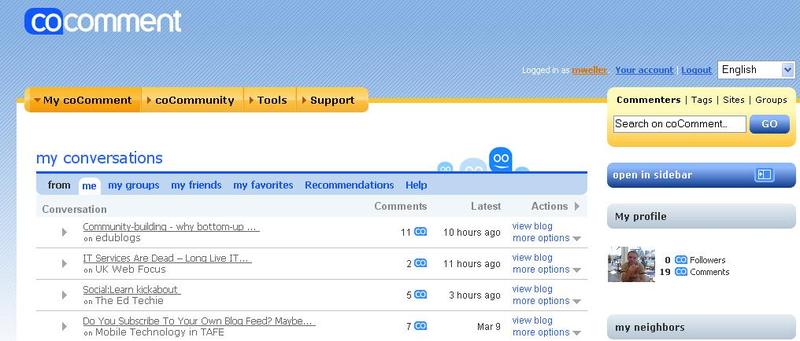
In my one man campaign to make technological determinism respectable, I installed CoComment because I think having a good tool will make me more likely to comment. First impressions are good - it installs on Firefox, and when you add a comment to a page it automatically adds it to the list of 'conversations' you are having. It has a social element so you can add people as friends or favourites, (not entirely sure of the difference). You can subscribe to the RSS feed of other's comments, or to one conversation. You can even claim your own comments on Technorati.

All this leads to some interesting reflections on the nature of comments. They form one of the second order modes of dialogue that operate around blogs (blogs really are the glue that holds the web together - why did we even have a web before blogs?). Twitter is another example of this second order, but unlike comments it can exist on its own. It overlaps with blogs, but isn't dependent on them.

Does it make sense to subscribe to someone's comments? Kind of, in that it will alert you to their thoughts on other people's postings. What CoComment adds for me is some stickability around comments - if I did post I wouldn't revisit and thus the conversation would be lost. Now I'm much more inclined to get involved in a debate.

Moving from being a provider to a meaner

Question: What have librarians, IT services and academics got in common (apart from occassionally questionable dress sense)?

Answer: All have one key element of their role undermined or removed by the web, which can be loosely described as provision of content or service.

Back around 1999 when the likes of David Noble were bemoaning that the internet would make academics redundant (he was the Andrew Keen of his day), us e-learning advocates would argue that merely providing content is not all that educators did. Which led to the oft-quoted move from the sage on the stage to the guide on the side.

Librarians have also faced a similar challenge from the internet. When everything is available and Google can find you it, what is the role of the library or the librarian? Part of their function was to store, organise and then help us find physical resources. This changes fundamentally when things become digital. For a start, the idea that librarians need to decide which one, and only one, category a book can go in, seems absurd in an Amazon world. It just isn't a task we require someone to do on our behalf anymore.

Then last week Brian Kelly posted his talk about IT services and web 2.0. I posted a comment about my recent Google conversion, claiming the type of tools I could get was an order of magnitude better externally. Andy Powell has a post about social networks and IT services, stating:

So what is the lesson here for institutions and institutional IT services? I think they need to take note.  Whilst (in some cases) they may have the technical competence to build global-social social services, it is not typically part of their function to do so.  To put it bluntly, their business is to serve the institution, not to serve the world.  As a result, IT services have to begin seeing themselves as the enablers rather than the providers of such services.

I think Andy hits the nail on the head here. This is actually the same solution for all three groups mentioned here. There are two basic rules we should follow here:

1) In a world where content and technologies are free don't fight against them - you cannot compete as the sole  provider.

2) Such a world is disaggregated, and complex. Therefore there is a need to help users with the skill set in combining these disaggregated components into a meaningful whole, be that a PLE (if you're IT services), a set of resources (if you're a librarian), or a course (if you're an educator).

So we are less providers now, more frameworkers. We need a new term for this - I propose the term my daughter uses for anyone who is less than generous to her - a 'meaner', since our role is to help add meaning to disparate components. Meaners of the world unite!