« December 2007 | Main | February 2008 »

In Palo Alto

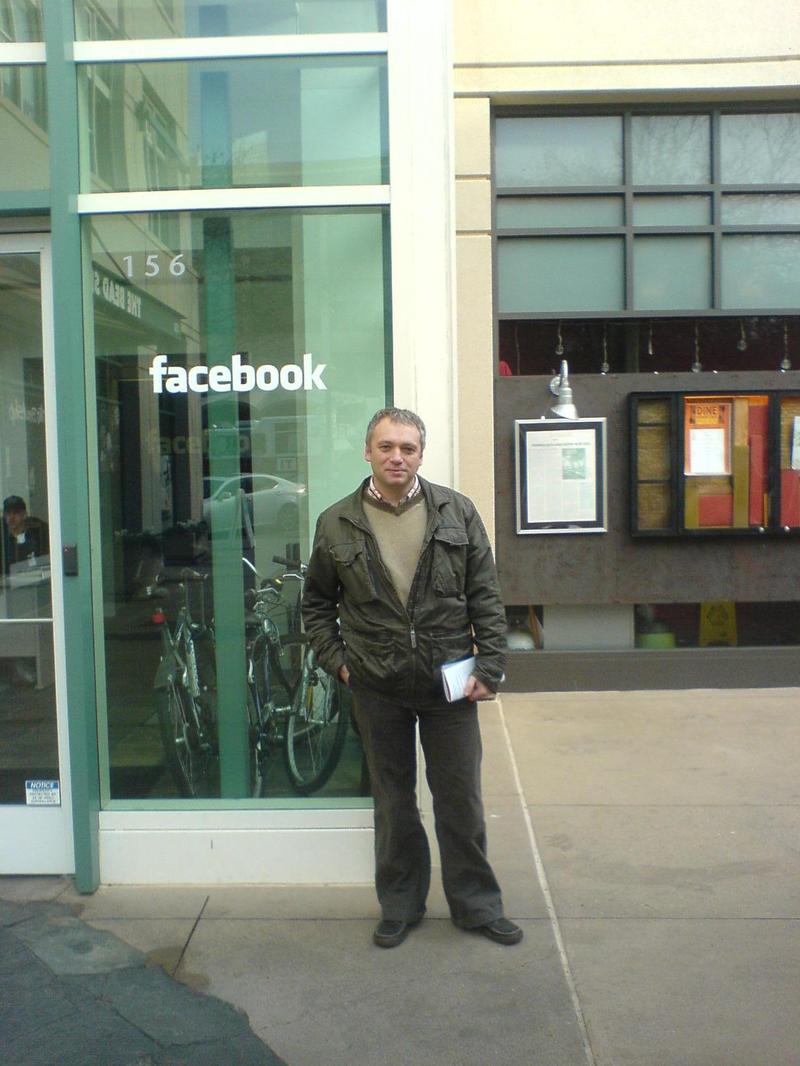
I'm in Palo Alto for a few days (I'll explain why in a later post). We've had some excellent meetings at The Institute for the Future and SocialText (where I saw Dan Bricklin chatting away - when I chaired T171 Dan Bricklin was one of the main characters in the history of the PC). But really this post is an excuse to show the obligatory Facebook shot:

Dsc00195

It's the geek equivalent of the summer bay shot in Australia.

Technorati as scholarly metric

Techrank

The other day my technorati authority finally nudged past 100. This is significant for me because in my annual staff appraisal meeting last year one of the goals I set myself was to achieve this. I did this because I wanted to test the whole staff appraisal system, and as part of my campaign to get blogging recognised as a scholarly activity, in the Open University at least. Having measurable outputs then is a means of bringing blogging in to the fold - like publishing a number of journal articles, or delivering a number of presentations. It's measurable, therefore it's real in the eyes of official processes.

Having achieved my goal (and ahead of schedule too!) I thought I'd reflect on it, in case anyone is attempting something similar. There are a number of questions one should ask about this use of Technorati as one measure of academic performance.

Firstly, is it reliable? This itself breaks down in to two parts: Is Technorati itself working reliably, and then is it a reliable measure of academic output. Taking the Technorati element first, I'd say - sort of. In my experience it sometimes gives odd results - my authority dropped when In posted two new items. Why would it decrease with new posts? It also hasn't picked up some people I know have linked to me, this may be because they are not listed on Technorati themselves. And it also takes ages to update sometimes. For some reason my blog is shown twice, with two different authorities. So, there may be some glitches, but overall it acts as a reasonable proxy to blogging reputation.

The second element was whether it is a good measure of academic output. Clearly Technorati itself doesn't care what I blog about. I could have increased my authority by blogging about Paris Hilton, or by indulging in blog wars and linkbaiting. That doesn't make it a good educational blog, so clearly your Technorati authority needs to be only one component.

After reliability we come on to desirability. Would it be good to have your Technorati authority (or any such measure) used as part of your scholarly output? There are two viewpoints to take on this, firstly from the educational establishment, and secondly from the blogging community. In terms of the establishment I'd argue that although there are issues around reliability, the same is true of traditional measures also. It is relatively easy to get publications out in some journals, to publish lots of papers from the same basic idea/research by only changing a small element between each and to get research students to do all the work. To combat this we end up with the convoluted and tortuous measures of esteem that are found in the RAE.

From the blogger's perspective the reaction might be 'please don't ruin blogging by making it one of your measurable factors.' Having seen what this has done to research publications (ie transformed them from a genuine activity to a game to be played for points), the last thing you'd want as a blogger is to have this area of creativity, engagement and enjoyment trampled over by herds of bean-counters. One can imagine what it would be like - points for rate of blogging, for your ranking, for the number of subscribers, etc. All of which would transform behaviour and ruin it. But, having said that if we bloggers truly think it is the best place for academic discourse, then getting it recognised as such may be important for encouraging new academics who need to keep an eye on their career path.

Overall then? For me it's been worthwhile having a specific target, and having some form of measurement I can feed into the system to have that activity recognised. Perhaps the thing to remember is that it doesn't matter what it means, after all is an authority of 100 good? Should it be 200, 700, or some other number? What does it mean in terms of reach? But there is a measurement in the system, and the system likes measurements, so it can rest easy.

Social networks - the definition thing

During the recent Economist debate on social networks, danah boyd pointed out that people were including lots of examples that weren't social networks. She suggested that we define our terms rigorously. While she's right that it's difficult to have a debate if we're actually talking about different things, this getting bogged down in definition is a habit that bedevils academic discourse to the point where we spend all our time debating what it is we will be debating.

Quick joke: How many academics does it take to change a lightbulb?

A: What do you mean exactly by an academic? And in what context are you using change? What type of lightbulb are we referring to?

In at least two subject areas I've contributed to over the past few years - learning environments and learning objects - the definition thing rumbled on endlessly. Every paper began with a look at definitions and then their own, and then a justification.

The problem is Wittgenstein's - as he pointed out any attempt to define the term 'game' is flawed since you can always find examples that do not fit the exact definition. As he argued we manage perfectly well to function without an exact definition of a game. What we have are (Jungian) archetypes - idealized representations of a concept, which individual instances can be nearer to or further from. There is thus a degree of membership. In our example, you would say Facebook is close to the archetype of a social network, but a wiki community less so.

I think this is a more pragmatic approach because any exact definition you come up with will exclude examples that are still of interest. Think of it as fuzzy logic and set theory - there is no strict cut off for when someone is tall, but some people are definitely tall (a value of 1), some are definitely not (a value of 0), while others are inbetween and it will depend on the judge and the context (a value between 1 and 0).

Put less pretentiously - if it looks like a social network, acts like a social network and if Scoble's on it, then it is a social network.

DIY Despair

If you haven't come across them Despair Inc offer parodies of those motivational posters you see up on the office wall of a David Brent type. Some are very funny indeed.

You can also create your own, so here is mine. This is what someone said to someone I know recently when discussing a project. If I wasn't moving to an open plan, I'd have it up on my wall. (image - TPorter2006 http://www.flickr.com/photos/tporter2/1392077364/).

Poster49702527

Pity the Google generation

Kid

(RadioFlyer007 - http://flickr.com/photos/radioflyer007/402409100/ )

First they're told they are the cut and paste generation, then they're told they don't exist.

John amongst others points to the British Library research looking at people's use of virtual libraries. The headlines of the report are that:

i) For some habits there is little evidence that youngsters use the internet particularly differently to others, we all have bad habits

ii) The behaviours people exhibit are: Horizontal information seeking, lots of time navigating, view rather than read, squirreling (ie downloading for later use), quickly assess authority for themselves.

iii) Young people do not find library sites intuitive and prefer Google

iv) Children make narrow relevance judgements e.g. 'does it contain the exact phrase I searched for?' and thus miss relevant documents.

There is a good section towards the end where they take a number of myths about the Google generation and assess whether they are true, giving a confidence on their verdict. For example, they prefer visual over text (Yes), They are expert searchers (No).

A lot of people (e.g. Nicholas Carr) have jumped on this as saying the Google generation a) doesn't exist and b) if it does exist has dumbed down. I think the report is more nuanced than that, some of the Google generation myths are borne out, others less so. This doesn't mean it is a myth overall - they are a generation that has grown up with Google, and that has influenced their behaviour.

Another point to note is that this is about the use of virtual libraries. This paragraph was interesting:

Many librarians have started to experiment with social software in an attempt to get closer to their users. They have a problem. Although research libraries spend millions of pounds providing seamless desktop access to expensive copyrighted electronic content: journals, books and monographs, much of this is news to their users. Either they do not know that the library provides this material, or they get to it, possibly via Google, and assume it’s `free’. Libraries are increasingly between a rock and a hard place: the publisher or search engine gets the credit, they just pick up the tab.

This gets us back to the whole future of content stuff, and fame vs fortune. I think a lot of users simply don't want to know about resources that don't make themselves available. When I'm searching Flickr for photos to use in presentations, I only search for those that have a Creative Commons licence. If you don't have this, you won't even get seen. The same often applies when I'm researching - if I come across a reference that is in a database I can't get access to, or hilariously, expects me to pay to read it, I don't bother (usually). I'll find the same sort of information elsewhere.

So the take away for me would be that the Google generation expect their resources to be freely available, and accessible via Google. Expecting them to go off to walled gardens with obscure search mechanisms is rather insisting they conform to our modes of behaviour, and then deriding them for not doing so seems churlish.

Cut

(stefanlucut - http://flickr.com/photos/stefanlucut/710279326/)

On the cut and paste generation report, to me this says 'children are given such crappy unengaging assessment that they can get away with cutting and pasting'. Isn't this relatively good behaviour on their part? They are doing what human beings do best, satisficing. They get away with the minimal effort required to complete the assessment, because it doesn't interest them, and because they can. If we devised better forms of assessment that were more imune to plagiarism and more interesting then you turn these cut and paste habits into research ones. Which brings us full circle - we're failing the Google generation by allowing them to have bad habits. John Connell has a good response on this too.

Disaggregated communication

Comms2_2

I was chatting with Tony Hirst the other day and we were reflecting on how varied our communication methods were amongst the Facebook project team (Tony, Stuart Brown, Liam Green-Hughes and me). We sometimes use Facebook itself to have a discussion, or we might have an email exchange. I can't really see any reason for why we use one instead of the other at any particular time, but these tend to be discussions along the lines of 'have you seen this?'

Then there are our blog posts and related comments. Sometimes we will respond to each other's posts in our own blogs, other times we will add a comment, but mostly this type of communication is more ambient - I know what Tony is thinking about or working on, and just as importantly, he knows that I know it, so when we meet we have a shared foundation for conversation.

And then we have twitter - we all follow each other, and so will sometimes send replies or direct messages, but as with blogging Twitter really provides a background to more focused discussion. I will know what they are working on, but also it helps maintain a social bond which is vital in an informal team such as this.

Occasionally we need synchronous interaction, and will use Flashmeeting or Skype.

Lastly, we meet up for beers and cross paths at workshops and occasional meetings.

I've put all this is a compendium mindmap, shown above. It gets more social as you move from work meetings anti-clockwise round to the beer. So, at least from the point of view of this grouping, face to face is both the least and the most socially oriented.

What Tony and I realised was that we didn't really register that we had all these methods of communication. Using them and maintaining an overall track of the dialogue is not difficult, it just feels natural. The reason this may be relevant is that in education we worry an awful lot about communication channels with students and having only one main method. Perhaps this disaggregation of communication is not as difficult to manage cognitively as we once thought and actually allows each medium/tool to be used to its best advantage. This only happens if you're comfortable with the technology though.

The Economist debate - my 2p worth

As most people have blogged, there is a debate on social networking in higher education over at the Economist. Ewan Macintosh takes the pro side.

For what it's worth here was the comment I posted:

In some ways the argument is irrelevant - it's like asking 'is alcohol beneficial to study?' You could argue either way, but regardless of what we think students are going to use it anyway.

But, that aside, let's look at what SNS offer - a sense of community, peer support, enthusiastic users, engagement with technology, resource sharing, democratic participation - hmm, these are all things we've been desperate to have in higher education for years. We've largely failed in many of these (as anyone who uses a VLE can attest), so why wouldn't we look at what happens in SNs? It would be remiss of us not to do so.

However, there are some big cultural issues that higher ed will need to get over - in particular HE is based on a very hierarchical model, and is often obsessed with controlling the student experience. In a social network you have to let go. In short you have to accept bottom up over top down - and that will be tough, as it goes against 3000 years of educational instinct.

So, my conclusion - of course higher education should try and adopt principles of social networks and 2.0, but the question is whether it can.

The Facebook lessons

2077892948_656f5f96a9_b

(avlxyz - http://www.flickr.com/photo_zoom.gne?id=2077892948&size=l)

So, as I said in my last post, this will be the year Facebook fades away for many of us. It won't disappear - I'll probably have a Facebook profile still, but I just won't use it much, rather like I have a LinkedIn profile that I never do anything with. So, before it goes and we become all dismissive about it, here are some of the good things the Facebook experience taught me. I am focusing here on personal lessons rather than the more general business models, or social network success factors which have been widely commented on (e.g. having an open API):

  • Social networking wasn't just for teenagers - prior to about May 2007 I had a few accounts in various social networking sites, but none of them did much. I read about kids loving Bebo, MySpace etc but I could often be found spouting the view that if you were over thirty they were of academic interest only, ie we liked to research them, but not actually use them (see below). Then Facebook reached a tipping point in terms of the people I knew on it (and these were people I liked and respected), and within a couple of weeks I was using it daily, updating my status regularly and building up a network.
  • The social dimension is important in a professional context - my Facebook network is consitituted from professional peers who I like. Whereas LinkedIn seems to be professional peers who are potentially good for business. So what I discovered through Facebook is that the intersection of the social and the professional is what is important in my network, not just one or the other. This doesn't mean I have to have met the people face to face, but usually through blogs we have some form of dialogue. This is of course something you know instinctively in a face to face work context - it's not just who you work with, but who you like working with that is important. But finding a means of extending this without it being intrusive has been something Facebook has given me.
  • You only understand it by doing it - as many people have commented (e.g. Ewan), in order to understand web 2.0 you have to act 2.0. I think too many academics are guilty of seeing social networking, or any popular tool, as something to be researched, but not something to be experienced and used. This is both rather a snobbish attitude and also misses the point. Signing up for an account, dropping in for a couple of weeks, doing a survey and then disappearing does not gain you an understanding of how these things are really being used.
  • Control of the student dialogue is over - if it was ever real in the first place. We can provide some official systems for students to use, but we can't make them use them. Through developing the OU Course Profiles app we've seen some students using Facebook as their preferred mechanism for discussion over the official VLE. They were doing this anyway without our app, so the question is whether you ignore it or support it (and what 'support' means in this context) - but controlling or denying it are not options. We have to accept this in higher education - it's a messy, disaggregated world now.
  • Universities need to be more flexible organisationally - the OU Facebook app came about because Tony had a chat with Liam and Stuart and they did it in their spare time. When I got involved it was to get some buy out of their time. The problem is that the OU, like all universities, doesn't really have the right organisational units or structures to deal with this new world. We have toyed with the idea of setting up a Facebook project, which would need official recognition and funding, have deliverables, a timeframe and end point. But, if you accept my proposal in the last post that actually we need to get used to a continual stream of tools we love for a few months, then you don't want a 'Facebook project'. You don't really want a project structure at all, you want people to coalesce around a technology, play with it, then move on to something else. This is a very difficult approach to realise in a large organisation where people have to be accountable for their time.
  • Fun is the killer app - a fact not only ignored, but positively treated with disdain by designers of educational software (at least in higher ed). Facebook was fun to use, your average VLE isn't.

I wonder if I'll be writing a similar post about Twitter in a year's time.

Facebook - the holiday romance

1443530999_16fbd2c24f_o

(Steve Sawyer - http://www.flickr.com/photos/stevesawyer/1443530999/)

One thing is certain for this year - it will be the year we fall out of love with Facebook. I know, I know, we only fell in love with it last year. As I've commented before, my Facebook use has dropped off considerably with the use of Twitter, and this week I've seen D'Arcy Norman announce his deFacebooking (as he put it in his status 'The ugly, it burns'), and via my Twitter stream Scott Wilson performing a kind of Facebook striptease, or deconstruction, as he removed the various apps, left groups, deleted his profile pic, etc.

Yes, Facebook will definitely fade this year. But before the real backlash begins and we mock anyone who uses it, I want to reflect on its uptake. In the next post I'll look at what it taught me, and in this one think about what this rapid adoption and then dumping means.

The first thing to say is that it isn't really because of anything Facebook has done. I think you can find logical reasons why you're divesting yourself of it - privacy, Beacon, spam/bacn, the very annoying feature of needing to install an app in order to see a message someone has sent you, etc. But really it's just that it's served its purpose and it's not as much fun anymore.

Now, a lot of people will be very smug about this, saying 'I told you so - I knew it wouldn't last and so I didn't bother.' This is to totally miss the point. We knew it wouldn't last either - Facebook was a holiday romance, not the great love of your life. And like holiday romances it was to be enjoyed while it lasted and approached with full gusto and enthusiasm - otherwise there is no point to it. One doesn't engage in a holiday romance cautiously (obviously I don't engage in them at all anymore, but we're in metaphor mode here), that's not their role. Their function is to be short-lived, intense, and perfectly encapsulated. And that's how many of us approached Facebook.

I predict that rather like holiday romances, when you get back to the humdrum of everyday life you become rather embarrassed by the degree of passion you felt. Similarly, there will be an unspoken competition this year to prove that you never really liked Facebook much anyway.

I blogged before that I think we are monoamorous with regards to type of software, rather like football teams, so you only love one social network, one VLE, etc. But maybe what the Facebook episode reveals is that while we may be monogamous within these relationships to types of software, they are shortlived and we are always getting ready to move. The modern day educational technologist needs to think of themselves as something of a Henry VIII figure - always falling in love then cruelly discarding the object of affection for the next one. But with less beheading.

Social objects - meaningful or meaningless

218169158_3da5c16fe3

(Image 'Socializing' Noamgalai http://www.flickr.com/photos/noamg/218169158/)

This is a follow up to my earlier post on Social Objects in Education, and is an attempt to wrap up some of the discussion around it and the thoughts these have prompted.

In my Twitter stream John Connell said he wondered if there was something of a tautology around social objects. I think I know what he means, and it relates to a point I'll come to later on definitions. Put simply the argument goes something like 'what's a social object?' Answer: 'It's an object that's social.' Something is a social object if it acts as a social object - the danger with this kind of circular definition is that it doesn't really get you very far. (I have similar reservations about deep and surface learning by the way). For now, let's park this objection (hope that's okay John) and hope it will work itself out if we continue to explore the concept.

Josie Fraser commented that

"Profiles ARE social objects. They're not a real person - they're a constructed representation around which interaction takes place - a specific kind of social object. They are artifacts which connect and make visible networks."

This extends the definition of a social object beyond the 'mere' content I was considering. Your user profile in Facebook, say, is itself a social object since you choose what information to display. I think this is true, if one considers FB, by choosing what applications to install on your profile you are creating a social object. In essence, you are throwing out a number of social hooks to the community to see which ones catch. For instance, if I install the LastFM application then presumably it's because I think the information about the last music I listened to is of some social value to my FB friends, however small that value is (I know most people's waking thought isn't 'what's Martin been listening to?'),

My colleague Andy Lane  argues that  content can be seen as a mediating artefact, which  reminds me of the work of Grainne who argued that

Mediating artefacts help practitioners and students to make informed decisions and choices in order to undertake specific teaching and learning activities. By using this concept of MAs and grounding this in relevant socio-cultural literature it is possible to begin to identify which MAs are appropriate for particular users in particular circumstances.
(Conole, G. (2005), ‘Mediating artefacts to guide choice in             creating and undertaking learning activities’, presentation             at CALRG seminar, Open University, 1st November 2005)

She argues that models, narratives, learning designs can form this function. Does this mean we should bundle them in under the social object umbrella too?

Stephen Downes says he doesn't agree that the network is built around the object (Hugh MacLeod's conjecture), instead arguing that

these so-called "social objects" - images, videos, and the like - constitute a vocabulary that is used by members of a network.

Let's say the social objects in this case are some academic pieces of content for now, e.g. some AV, articles, books, etc on a particular subject. In the sense that the objects inform the dialogue between the participants, and they talk about the objects, then yes, they do constitute a form of vocabulary. For example, learner1 might say 'but we saw in the Wisdom of the Crowds that the mass can make immediate judgements that are better than any single member of the group.' Here 'the Wisdom of the Crowds' is part of a shared vocabulary, the book is the social object, and that is used by the members of the network as Stephen suggests.

However, also imagine this scenario - learners with an interest in, say Ancient Greece in a social network share content resources (through something like the visual bookshelf) and then decide to come together for a discussion on, say, the role of Themistocles in ancient Greece, around a wiki article on him. In this sense,  it is more than a shared vocabulary they are using (although they need that too), but the social object (the resources and the wiki article) are the social objects which are igniting and focusing their discussion.

Lastly, David Wiley links us back to the work on learning objects, and in particular the metaphor he proposed then of the campfire - ie the social glue that brings people out of their tents:

Without a campfire all you have is a bunch of tents setup and people wandering around disconnectedly. The campfire provides a place for people to congregate and interact. The campfire appears before the singing starts.

That last point is significant - the campfire appears before the singing starts, not the other way round. In the comments I replied to David saying that the link to learning objects occurred to me also for two reasons:

i) Are social objects just learning objects that you deliberately create with social interaction in mind (lots of work on LOs seemed to be about interaction with the LO itself, ie they were conceived as multi-media objects)

ii) like with LOs the debate around social objects quickly becomes bogged down in one of definition. Almost every discussion I had about LOs started and ended with ‘but what is a learning object?’

I'm not entirely sure where this leaves us regarding social objects. Part of these blog posts is to help me think it through in a social manner, as all the above comments demonstrate. Rather like terms that become popular in academic circles the debate is often about whether they really add anything. Affordances was another such term, which once it moved beyond the strict Gibsonian interpretation became too loose for many people to be comfortable with. I take a fairly pragmatic stance on the use of such terms - don't get bogged down in an exact definition, if you have an intuitive take on what they mean and it helps stimulate thought, debate, development or research then that's good enough. And that's where I am with social objects at the moment.