« November 2007 | Main | January 2008 »

The Selfies - award your own blog

After the Eddies and the Downesies, and in the spirit of end of year reviews, I've decided to award myself some Selfies, ie awards for my own blog given by me.

Here they are:

Best post

I think I'll give this to the Future of Content debate. I'm not sure it worked as an integrated article, but I enjoyed the discussion and playing with the format. This is probably the closest I've come to something that compares with 'proper' scholarly output in my blog.

Worst post

Aside from this one, I think the Lexicon for real world/virtual world interaction was a naked bit of linkbaiting. And it didn't even work. Sorry.

Favourite widget

I do like having my Twitter posts showing up on but I think I'll give this to Ligit. I don't use it a lot but socially enhanced search is going to be big I reckon.

Favourite use of media

I don't use embedded media much (see below) so haven't got a lot to choose from. So it's a no-brainer to go for Slidecasts. Insomnia sufferers will be pleased to hear I plan to do more of these next year.

Most irritating habit

I seem incapable of doing a post:

  • that doesn't
  • include
  • a list
  • of some sort.

Biggest area for improvement

If we accept I'm not going to have a personality change and become more interesting, than I really am too text based. I need to use more images, and this is my resolution for next year, to add more 'design' to my posts.

Best linker

Tony Hirst and I have a kind of extended blog dialogue going, but I'll give this to AJ for outing me as a Spongebob fan.

Technorati basher

The post that most improved your technorati ranking. It was probably the Future of content one, but I'll give it to The VLE/LMS is dead, because it was a post I knocked off quickly and was surprised by the interest it generated. Which goes to show, you can never tell what posts will spark off a debate in the blogosphere.

So there they are, the Selfies: indulgent, self-referential and pointless. Bit like the Oscars really...

The tension between out there and in here

Following on from the Facebook post, the work we have done has raised some interesting tensions between developing for a third party platform and those services provided by the institution, such as the VLE. These will be issues that many universities will have to face in the coming years, so I'll list the ones I think are important here. I don't have any answers to them, I just know they're things we can't ignore. I'll use Facebook as an example to illustrate the points, but they can apply across nearly any third party application which isn't directly integrated into the formal learning experience.

  1. Does having interaction across multiple platforms dilute the overall effect? For example, if a subset of students start collaborating in Facebook does this have a negative impact on the dialogue and learning experience for the whole cohort in the VLE?
  2. Even if 1 is true, can we do anything about it? Many students are connecting and communicating via Facebook before they even start their courses. It would be unrealistic to expect, or to mandate, that they stop using whatever system they like for communicating. For example, someone else had already created an OU courses profile application in Facebook, so maybe it's better if we deliver these tools.
  3. What are the privacy issues and responsibilities? If a university develops applications for a platform is it implicitly endorsing that platform? For example, in Facebook when you join a network the default setting is that everyone in that network can see your full profile. Imagine some unsavoury student X starts bothering student A through this. Student A only joined Facebook because her university had developed some tools for it and seemed to be encouraging it. Where does the responsibility lie in this case?   With the student (for not controlling their settings)? With Facebook? With the university?
  4. What are the support issues? For instance on the Open University Facebook page some students have started raising tech support queries. Sometimes they get a response, sometimes they don't, since this isn't an officially recognised support mechanism. Logistically handling queries across multiple platforms will soon become unmanageable. Is this problem exacerbated if the university has a semi-official presence on the platform in question?
  5. What are the real benefits? Maybe none, but I think there will be some subtle ones, which research will dig up over the next few years. Will they relate to educational performance, ie those students connected through Facebook tend to do better because they have better quality peer support and find a range of alternative resources. Or will they relate to motivation? Maybe those students in Facebook tend to drop out less because they have peer support and pressure. Or will it influence satisfaction? Students in Facebook tend to rate the course better because they felt better connected to the cohort. Or maybe none of these.

I think the natural instinct of universities (and particularly senior management) when faced with issues such as these is to think 'more control'. As readers of this blog will know, I tend to favour less control, but that doesn't mean it will be a smooth ride. There are some potentially very difficult issues, and a few legal cases, to be addressed as we blur the boundaries between out there and in here.

Not an Eddie, but a Downesy will do

Tony, Peter and I may have just missed out on getting an Edublog award for the OU, but bless Stephen Downes, he's come up with his own alternative list. This time the OU Facebook Project gets an award for 'Best educational use of a social networking service'. He says:

What makes this different from the typical use of a social networking service is that it is substantially about using a social network service to support learning, rather than simply using it to connect the same old group of people together. What I mean by this is that it is intended for students and that it inserts a useful educational service into the social network application

The OU Facebook team is really Tony Hirst, Liam Green-Hughes and Stuart Brown, with me on the periphery. There are now around 2,600 users of the courses profile application that allows users to find others studying the same course. Using this one bit of information you can then add functions such as find a studybuddy, recommend courses, comment on courses, and see what other courses people have taken. There are a number of other apps in the pipeline, which the team can tell you about in their blogs.

In the meantime here we are celebrating.

[UPDATE - Stuart Brown has some more info on the Facebook app, including users and projected updates]

Readers' favourite apps as mindmap

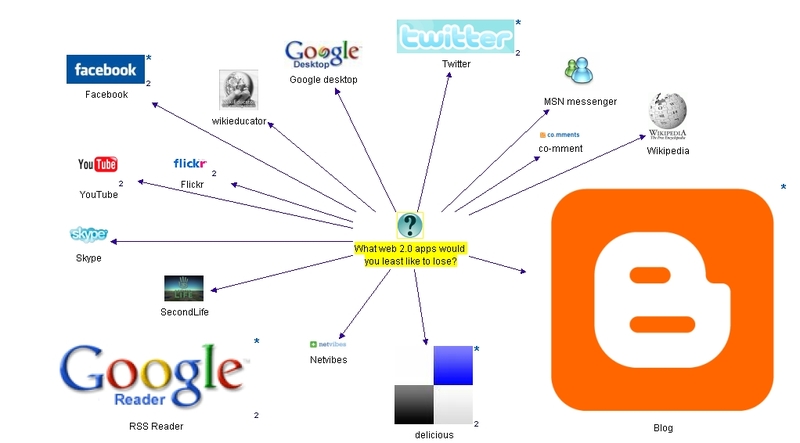
I asked recently which three web 2.0 apps would you least like to lose, and had a few responses. So, in the interest of playing with Compendium a bit more, here they are as a mindmap, with the size of the logo representing the number of responses for that category. I've bundled some together, and used a recognisable single product logo, so for example some people said 'Bloglines' and others 'Google Reader' but I've put these all together here. The same goes for the generic 'blog' - people didn't usually specify which blogging tool, so this isn't really an endorsement for Blogger, they just have a nice logo.

It is not a very broad sample, ten people in all, but here it is, for what it's worth.

Apps_2

You can see the blog is the clear winner, followed closely by, erm, a blog reader. Maybe asking a blog reading audience isn't the best sampling method, but it does reinforce to an extent a previous point I have made about your blog being your basecamp in the online world.

StumbleUpon - seeing democratisation in action

The traffic to this blog bumps along around 100-200 hits a day. Occasionally it goes up if someone like Stephen Downes links to me, and it goes down if I don't post for a while, for example over the summer holidays. Overall though, it's pretty constant (as an aside, I have the vague feeling that mentioning your traffic figures is a bit of a social faux pas, rather like stating your salary).

Then on Sunday I had a massive spike of nearly 700. But it only lasted one day, on Monday it was back to normal. This is higher than I've had even when David Weinberger linked to me, but then his effect lasted over several days.

The cause of this spike was that two people had reviewed my post on 'My personal working/learning/leisure environment.' One of these Julia Lesage, an academic in Oregon. She is a big stumbler obviously, and her effect was considerable. I find this interesting because of all the talk of the democratisation of power, you need real examples to bring it home. For all the marketing you might want to do, the formal reviews you might want to commission, the real power lies with a silver haired lady in Oregon...   

The Christmas Twitter Game

I'm a (not very good) runner, and one of the discussions that often comes up this time of year is whether you will go for a run on Christmas day. The responses tend to fall into 5 categories:

  1. Of course, it's just another day and I've got to stick to my training schedule.
  2. It's great to get some exercise in before all that indulgence.
  3. No, it's kind of showing off, declaring 'look how committed I am, I run on Christmas day'
  4. Yes, I like to show off and declare 'look how committed I am, I run on Christmas day'
  5. I'd like to but I'm too hung over from Christmas Eve

If we replace running with twittering (or Facebooking or blogging if you prefer), then we have an ed tech equivalent. I wonder who will be up on Christmas day posting tweets such as 'opening a bad jumper from my parents' or 'eating a fifth mince pie'. I'm declaring now that I'm out - no tweets from me on Christmas day.

The Christmas Twitter Game - I'm compiling a secret list of people who I think will twitter on the day itself, and come boxing day I'm going to score my predictive powers. Hey it beats watching the Wizard of Oz on TV again.   

ELQ funding and the Brown psyche

As many in the UK will know the Government has decided to stop funding ELQ students (Equal or lower qualification), so if you are a student who is studying for a qualification equal or lower to one you already possess you have to pay the full fee. This is obviously vexing for a university such as the OU, which specialises in such qualifications.

It's also completely at odds with any agenda on lifelong learning, which the Government, and Gordon Brown in particular, claims to support. There has been some suggestion that lifelong learning will be funded in other ways, but just in case any Labour MPs are in any doubt, let's be clear - it is impossible to hold both concepts in your head simultaneously without conflict. It would be like a minister declaring they wished to increase atheistic thought in society by opening up a set of faith schools (or vice versa). The two actions are mutually exclusive.

And this is where we see the strangeness of Gordon Brown's personality come to the fore again. I accept that all politicians want to have their cake and eat it, but Brown seems peculiarly afflicted on this front, wanting to have his cake and eat it and then be admired by cake-eaters and cake-keepers alike (cf. being present or not to sign the European treaty). I ought to say that in case anyone interprets this as a Tory political broadcast, it isn't - I remember how education fared under them last time round.

This is what psychologists call a double-bind and used to think was a cause of schizophrenia (before they admitted that genetics might have a role to play, and double-bind seemed to be a load of old tosh in the causation stakes).

Anyway, the e-petition against the ELQ cuts is here if you feel like tightening the bind.

The beautiful use of statistics

If ever you wanted to enthuse someone about data and statistics then show them Hans Rosling's TED presentation 'New insights on poverty and life around the world.' The stories you can tell with good data and visualisation tools are beautifully illustrated in this talk. And I love the phrase 'grandma verified statistics.'

-->

(Hat tip: D'Arcy Norman)

Some thoughts on 'Founders at work' (or 'why I'm not a millionaire')

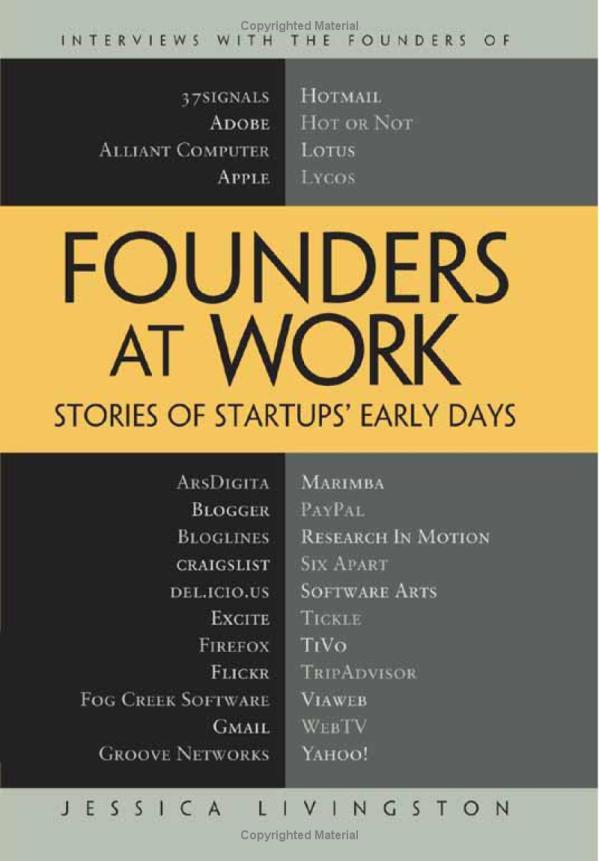
Foundersatwork_2 I recently read the fascinating 'Founders at work' by Jessica Livingstone, which has interviews with a range of tech start-up people. The insights are interesting, although I would say it's hard to draw many general rules for success from the book. Here are some observations:

  • Working with friends or people you find interesting is the starting point, not the technology or idea, which often comes later. This seems to me something we rarely take on board as individuals or organisations. Several interviewees said they met some people at college and knew they wanted to do something with them, but didn't know what.
  • It's a young man's game. Not many women in the book, and not many 40 year old professors either. Being prepared to literally sleep at work and share your house with your co-founders seems to be common. Many interviewees reported how they only saw their workmates, they lived together, socialised together, but mostly worked together. You can only do this when you're fresh out of college and don't have a family. 'Work-life balance' is not a phrase you'd hear often.
  • Money isn't the motivating factor. Sure most of the founders dreamed of success and riches, but that wasn't their main motivation. It was passion for the technology they were building or the vision they had for it.
  • Luck is a big factor. Not many of the founders had gone on to have repeated success, maybe because they weren't as motivated this time around and had acquired a family, but also because as many of them suggest, luck is a major factor in success. Often it will be a small decision that has big consequences, or a chance meeting, or an opportune moment in the market.
  • Get bought out by a big player is a common business model. I want to explore this in a later post, but for many of those interviewed they only really had financial success when Microsoft (or someone similar) bought them out for X million. This doesn't really constitute a business model to me, as it isn't really generating revenue from your product, just hoping someone with lots of spare cash goes in to acquisition frenzy because they need to clear some accounts.

If you haven't read it, then it's worth a read. Be warned though, you might feel a tad envious the next time you get your more modest pay.

The edublog awards experience

The awards ceremony for the Eddies was on Saturday night in SecondLife. I'm not much of a SecondLifer, and besides, spending my Saturday night in a virtual world is probably grounds for divorce, so didn't attend.

I was up in the Best Ed Tech Support category, which was won by El Tinglado. Congratulations to them, I think it's great to see a non-English blog winning - there is a tendency to first of all be North-America-centric about blogs and then English-speaking centric.

I thought I'd reflect on the experience of being nominated. One of my informal roles at the Open University is blog evangelist, and as part of this I see one of my aims is to get blogging recognised as both a valid scholarly activity and also beneficial to the organisation as a whole. Having three OU nominees up this time (me, Tony and Peter Twining's Schome project) has been the first concrete indicator I can use that there is external recognition for this sort of output. It has also given me an opportunity to raise the profile of blogging across the university, and particularly with senior management.

This to me is the real importance of the Eddies - they provide an opportunity for blogging activity to be recognised. We can talk about how great blogs but if it's only self-validation then it's easy to be dismissed. As soon as there is some form of external validation then people tend to pay more attention.

The other very useful thing has been that it has introduced me to some other blogs, and by being part of the nominees, the bloggers behind them. I'm going to use the 'C' word here - yes, I feel a bit more part of a community. And that's got to be a good thing.

The only downside is that, as Tony has highlighted, the voting process seemed a bit unreliable. I don't think this matters too much for the Eddies since one can truly say, 'it's the being nominated that counts', but if we wanted to really vote on something serious we'd need to find ways of addressing these issues.

So, thanks to Edublogs and Josie Fraser for organising it, I'm already looking forward to next year.